
Formic acid occupies a narrow but valuable slot in a varroa programme. It is one of the few treatments that reaches mites inside capped brood, and it can legally be applied while honey supers are on the hive. Those two properties are why commercial operations keep it in the rotation even when cheaper synthetics exist.
It is also the treatment most likely to be applied wrong. Formic acid works by vapour. Vapour release rate tracks temperature, and the window between “too cold to work” and “hot enough to kill brood and queens” is narrower than most beekeepers expect.
Why formic acid still earns its place
Three properties separate it from the rest of the shelf.
It penetrates cappings. Most soft treatments predominantly hit phoretic mites riding on adult bees. Formic acid vapour reaches mites reproducing inside capped brood cells, which is where the majority of the mite population sits during the season.
It can be used with supers on. That is unusual and commercially significant, because it lets an operation treat during a flow rather than waiting for a gap that may not exist.
There is no established resistance. The same cannot be said for tau-fluvalinate, where resistant mite populations are documented across North America. Rotating away from synthetics onto formic acid is a resistance-management action as much as a mite-kill action.
Against that: it is corrosive to handle, it has a hard temperature ceiling, and a badly timed application can cost you queens.
The temperature window, and why it is the whole game
The UK product characteristics for MAQS — a 68.2 g formic acid strip — state that the product should not be used when peak temperatures on the day of application fall outside 10–29.5°C. Above that range, brood mortality and queen loss rise sharply, particularly in the first three days of treatment. Below it, evaporation is too slow and efficacy collapses. Formic Pro, the widely used North American formulation, is labelled for 50–85°F, which is roughly 10–29°C, with a 14-day application for the two-strip dose.
Note that the label means ambient temperature, not hive temperature. A strong colony runs several degrees warmer inside than the air outside, which is why experienced operators treat on the cool end of the window rather than at the top of it.
That single constraint explains most regional formic acid practice. In temperate regions the usable windows are spring, after the main flow, and early autumn before nights turn cold. In hot-summer regions the window can close almost entirely for two or three months in the middle of summer — which is exactly when mite counts peak. Operations in those climates need a different primary summer treatment.
| Treatment | Label temperature window | Application period | Reaches mites in capped brood |
|---|---|---|---|
| Formic acid (MAQS) | 10–29.5°C on day of application | 7 days | Yes |
| Formic acid (Formic Pro, 2 strips) | 50–85°F (approx. 10–29°C) | 14 days | Yes |
| Oxalic acid (vapour or dribble) | Broad; brood state matters more than temperature | Single or repeated | No |
| Thymol (Apiguard) | Roughly 15–30°C | 2–3 applications | Partial |
| Amitraz strips | Wide functional range | 6–8 weeks | No |
Windows quoted here come from registered product labelling and the Honey Bee Health Coalition varroa guidance. Labels differ by country of registration — always work from the label that applies where the hive stands.
What the efficacy numbers actually say
Field efficacy for formic acid spans a wide range, roughly 61% to 98%, because the number is dominated by conditions rather than by chemistry. Under good conditions — correct temperature, correct placement, adequate ventilation — results cluster near the top of that range. A 2019 comparison of organic acid treatments recorded about 90.6% mite kill from a 14-day Formic Pro application in colonies that still had capped brood, which is the harder target.
Two things reliably push a result down: heavy drone brood, where vapour penetration into the larger cells is less consistent, and a colony carrying far more mites than the treatment was sized for. If your monitoring says mite load is already severe, a soft acid alone is unlikely to rescue it.
For context on the alternative: oxalic acid achieves 82% to 99%, but only when brood is absent. That is why oxalic dominates the winter broodless slot while formic holds the in-season slot. They are complements, not substitutes.

Application details that get skipped
- Ventilation. The bottom entrance must be fully open, full hive width, with a minimum height of 13 mm, for the entire treatment period. Entrance reducers and mouse guards must come off. This is not a formality — restricted ventilation is what turns a treatment into colony damage.
- Treat the whole apiary at once. Partial treatment just moves mites between colonies through drift and robbing.
- Colony size. MAQS is labelled for colonies covering at least six frames, roughly 10,000 bees. Smaller colonies cannot buffer the vapour concentration.
- No feeding during treatment. Feed and treat are separate operations.
- Honey withdrawal. For MAQS the withdrawal period for honey is zero days, but do not harvest during the 7-day treatment period itself.
- Handling. Formic acid is corrosive and irritant. Chemical-resistant gloves to EN 374, eye protection, and open the packaging outdoors standing upwind.
- Do not disturb the colony during the treatment period. Disturbance raises the risk of brood and queen mortality and can trigger absconding.
Where acetic acid fits
Acetic acid belongs in a different job. Its main use in commercial beekeeping is fumigating stored comb, supers and equipment — against wax moth and against American foulbrood spores on gear — rather than as an in-hive varroa treatment on a live colony. An adjustable dispenser that meters either acid is therefore useful to an operation for reasons beyond mite control, and distributors selling to commercial yards should position it that way rather than as a mite product alone.
American foulbrood is a notifiable disease in most jurisdictions and equipment hygiene is part of compliance, not just good practice. The EPA pollinator protection guidance covers the broader pesticide and treatment context, and national bee health units such as the National Bee Unit publish the notifiable-disease rules that apply locally, and the World Organisation for Animal Health maintains the international standards that trade and movement rules are built on.
Fitting formic acid into a rotation
A rotation is not a list of products; it is a sequence matched to the colony’s brood state and the calendar. The logic runs like this.
In season, with brood present and supers on — formic acid. It is the only common option that hits mites under cappings while honey is being stored.
After the flow, still warm, brood reducing — thymol, or a second formic application if the temperature band still allows it. Watch the forecast ceiling.
Broodless or near-broodless window in winter — oxalic acid, by vapour or dribble. Efficacy is highest when there is no capped brood to protect the mites, and the treatment is not temperature-limited in the way formic acid is.
Resistance management — rotate mode of action between years rather than repeating the same synthetic. Where tau-fluvalinate resistance is established in a region, a synthetic strip that worked five years ago will not deliver the same result now, and the only way to know is to count mites after treatment rather than assume.
Two habits separate operations that keep colonies from those that do not: monitor monthly during brood rearing and treat on a threshold, and re-count after every treatment to confirm it worked. Mite levels rebound fast, and a single late-summer treatment rarely carries a colony through to spring.
Mistakes that cost the most
Ranked by how often they show up and how much they cost:
- Treating above the temperature ceiling. The most common cause of queen loss with formic acid. Check the forecast high for the following three days, not just today.
- Leaving an entrance reducer in. Ventilation is the difference between a treatment and a colony stress event.
- Treating a colony that is too small. Below roughly six frames of bees, the vapour concentration is not tolerable.
- Treating part of an apiary. Mites redistribute and the work is wasted.
- Using it as the only summer tool in a hot climate. If your summer highs sit above 30°C for weeks, formic acid is not your summer treatment.
- Storing strips badly. MAQS should be stored below 25°C, dry, out of direct sunlight, in the closed original container.
Where formic acid sits in a rotation

Rotation only works when you rotate between mode-of-action groups, not between products. Soft acids occupy a specific slot: they are the tool that still reaches mites under cappings, which makes them the natural choice when brood is present and when a synthetic class has already been used earlier in the season.
| Season position | Brood status | Why formic fits | What it does not solve |
|---|---|---|---|
| Early season build-up | Rising brood | Penetrates cappings, so a count taken now can be acted on now | Requires stable daytime highs; a cold snap stalls the release |
| Mid-season, post-synthetic | High brood | Different mode of action from pyrethroids and formamidines | Does not remove accumulated wax residues from earlier strips |
| Late season, before winter bees | Falling brood | Protects the bees that have to overwinter | Temperature window narrows fast; check the forecast, not the calendar |
| Mid-winter | None | Not the tool — broodless colonies suit oxalic acid | Cold release is unpredictable and the colony cannot ventilate |
The practical rule is simple: treat on a count, pick a group you have not used recently, and confirm the label’s temperature band before the box is opened. Guidance on how the groups are defined is maintained by the Honey Bee Health Coalition, and product registrations in the US are listed by the EPA.
Where to get the equipment
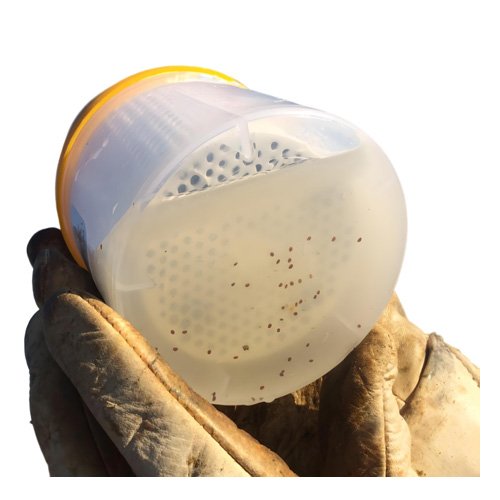
Dispensers that meter the evaporation rate are the practical answer to the temperature problem, because they let you hold release inside the usable band instead of hoping. The adjustable formic and acetic acid dispenser and the adjustable evaporator are built for that, and both cover acetic acid use for equipment fumigation. The wider feeders and medicine category carries the rest of the treatment range.
Whatever you apply, treatment without monitoring is guesswork. Pair any acid programme with a mite count — the Varroa Easy Check is the quickest field method — and treat on the count, not on the calendar.