

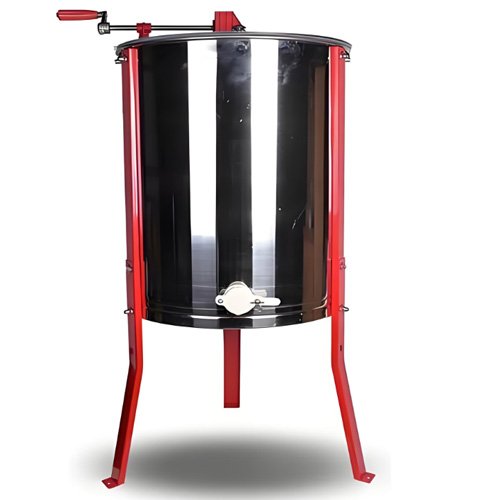
The manual-versus-electric decision is usually framed as a budget question. It is really a labour question, and it has a crossover point that can be calculated rather than guessed. Below the crossover, a hand-crank machine is the rational buy. Above it, electric pays for itself in a season or two, and the manual machine becomes the expensive option because of the hours it consumes.
This is aimed at operations and distributors who need to justify the step up, not at hobbyists who simply prefer cranking. The arithmetic is not complicated, but it does require being honest about how many frames actually go through the machine each year.
What you are really buying with a motor

A motor buys three things, and only one of them is speed.
Consistent speed. A crank delivers whatever the operator’s arm happens to produce. Ramp-up is uneven, which is when comb damage happens. A motor with a controller gives a repeatable curve, and repeatability is what protects comb across a whole harvest.
Hands-free time. This is the big one. On a manual machine an operator is physically attached to the drum for the duration of the cycle. On an electric machine with a programmed or manually set controller, the operator uncaps the next batch while the current one spins. The extraction step stops being a bottleneck and becomes a background task.
Controlled torque. A heavy load brought up to speed gradually is safer for frames than a cranked load that is accelerated hard. Combined with a soft ramp, this is why electric machines of the same nominal capacity tend to damage less comb in practice.
What a motor does not buy is a shorter cycle. A well-run electric cycle is not dramatically faster in minutes than a well-cranked one. If you are expecting the machine to spin quicker, you will be disappointed; the saving is in the operator, not the drum.
Capacity bands, as a starting point
Capacity bands are a starting point for a conversation, not a specification — the peak-week calculation always overrides them. That said, most operations land in one of these:
| Operation | Frames per season | Usual answer | Reason |
|---|---|---|---|
| Hobby | Under 100 | Manual 2–3 frame | Payback never arrives; storage and portability matter more |
| Small sideliner | 100–400 | Manual 3–4 frame, or small electric tangential | The crossover zone; decide on whether power is available at the extracting site |
| Sideliner | 400–1,500 | Electric 4–9 frame | Operator hours become the binding constraint |
| Commercial | 1,500–6,000 | Electric radial 12–24 frame | Continuous cycle; uncapping becomes the next bottleneck |
| Large commercial | Over 6,000 | Two mid-size electrics, or one large radial plus backup | Redundancy and continuous flow matter more than peak capacity |
Read the bands with two corrections in mind. A very short, intense flow pushes you up a band, because capacity has to cover the peak week rather than the annual total. And a long, gentle flow can pull you down one, because the same annual volume spread over more working days needs less machine.
Where the hours actually go
Break the extraction task into steps and the difference becomes obvious.
| Step | Manual | Electric | Why the gap exists |
|---|---|---|---|
| Load frames | Operator time | Operator time | Identical |
| Bring up to speed | Cranking, several minutes | Controller, unattended | Motor runs unattended once set |
| Hold at speed | Cranking throughout | Unattended | The largest single block of recovered time |
| Ramp down | Operator stops cranking | Automatic or brief | Small |
| Unload | Operator time | Operator time | Identical |
| Concurrent work | None possible | Uncapping, filtering, bottling | The real productivity gain |
The last row is where commercial operations win or lose. On a manual drum, uncapping and extraction are sequential. On an electric drum they run in parallel, which roughly halves the elapsed time of a harvest day at the same staffing level.
The break-even calculation
Three inputs decide the answer. None of them need to be guessed precisely — a rough figure is enough, because the crossover is usually obvious once you write the numbers down.
- Frames extracted per season. Count supers pulled, multiply by frames per super. Be honest about the peak year, not the average.
- Operator hours tied up per season. On a manual machine this is essentially the total spin time plus the flip handling; on an electric machine it is load and unload only.
- What an operator hour is worth to you. For a commercial operation this is a wage plus overhead. For an owner-operator it is whatever else you would be doing — and in a compressed harvest, that is usually not nothing.
Multiply recovered hours by the value of an hour and compare against the price difference between the two machines. If the payback lands inside two seasons, buy electric. If it stretches past four, and your frame count is genuinely low, the manual machine is the correct financial decision and there is no shame in it.
Two adjustments usually push the answer towards electric once you apply them. First, harvest is compressed: the hours you recover are concentrated into the few weeks when labour is scarcest and most expensive. An hour saved in the harvest week is worth more than an hour saved in March. Second, fatigue. Cranking a loaded drum for hours on the third consecutive day produces worse handling and more comb damage than any calculation captures.
Duty cycle: the specification people forget
Motors are rated for a duty cycle, and extraction duty is punishing. A harvest means long runs, repeated starts, heavy unbalanced loads, and a warm, sticky environment. A motor rated for intermittent use will not survive it.
When you specify, ask for:
- Continuous or heavy-duty rating, stated on the quotation, not implied.
- Voltage and frequency for the destination market. A 50 Hz machine on a 60 Hz supply, or the reverse, will run at the wrong speed and overheat.
- Starting torque capability for a fully loaded basket, since that is the worst case.
- Thermal protection, so a stalled or overloaded drum trips rather than burns out.
- Controller type — a variable speed drive with a soft ramp, not a fixed-speed switch.
- Ingress protection appropriate to a wash-down environment.
For importers, add two commercial points. Confirm the machine ships with the correct plug and documentation for the destination market, and confirm the controller is supported locally — a proprietary drive with no local spares is a liability regardless of how good the drum is.

When manual is still the right buy
Manual machines are not obsolete. Four cases justify them.
Very low frame counts. If you extract a few dozen frames a year, the payback never arrives and the manual machine is cheaper to own, store and maintain.
No reliable power. Remote yards and off-grid extraction sites cannot use an electric drum. A hand-crank machine works anywhere, which is why it remains standard in parts of Africa and Central Asia where apiaries are far from supply.
Mobile extraction. A manual drum is lighter, has no motor to protect, and tolerates being moved in a vehicle.
Training and demonstration. Manual machines show the process transparently and are common in teaching apiaries and development programmes.
A distributor should stock both. The manual units sell to entry-level and off-grid customers; the electric units sell to everyone who has crossed the break-even line — and the second group is where the replacement and upgrade business comes from.
Maintenance: what each type actually demands
Both types live in the same hostile environment: warm, acidic, sticky, and washed down at the end of every session. Honey is hygroscopic and mildly acidic, so any film left on a surface attracts moisture and then corrodes it. That is why cleaning discipline matters more than machine type, and why stainless grade and weld finish are worth specifying up front. The USDA Agricultural Research Service publishes the underlying bee and honey handling research that most commercial hygiene practice is built on.
| Task | Manual | Electric |
|---|---|---|
| Routine cleaning | Drum, basket, gate | Drum, basket, gate; keep the motor and controller dry |
| Mechanical checks | Gear or chain drive, lubrication, handle wear | Belt or drive tension, bearings, motor mount |
| Seasonal | Lubricate moving parts, inspect for corrosion | Inspect cabling and controller, check thermal protection, verify ramp behaviour |
| Failure mode | Wear is gradual and visible | Electrical faults are sudden; spares matter |
| Off-season storage | Dry, covered | Dry, covered, controller protected from moisture |
The practical difference is that a manual machine degrades visibly and an electric one fails suddenly. That is an argument for holding spares rather than an argument against electric.
Sizing the motor to the drum, not to the frame count
Motor sizing is where a lot of imported machines are quietly under-specified. The frame count tells you the basket size; it tells you nothing about the torque needed to accelerate a full load of wet frames from standstill.
Three parameters matter. Starting torque — the worst case is a full basket at the beginning of a run, when the honey is heaviest and the load is least likely to be perfectly balanced. Running power, which is lower than most people expect once the drum is at speed. And braking, which some controllers handle actively and some leave to friction.
The practical question to put to a supplier is not “what size motor is it” but “what is the rated duty cycle, and what happens on a deliberately unbalanced full load at maximum ramp rate”. A manufacturer who has actually tested the machine will have an answer. One who has not will describe the motor in watts.
Power supply realities by destination market
This is a specification, not a footnote, and it is the single most common cause of a machine arriving somewhere it cannot be used.
| Market | Typical supply | What to confirm before ordering |
|---|---|---|
| European Union, UK | 230 V, 50 Hz, single phase | Plug type, CE or UKCA marking, declaration of conformity |
| United States, Canada | 120 V, 60 Hz (240 V for larger machines) | Whether the machine needs a 240 V circuit; NRTL listing where required by the buyer’s insurer |
| Australia, New Zealand | 230 V, 50 Hz | Plug type and compliance marking expectations |
| Middle East | 220–240 V, 50 Hz (some 60 Hz) | Ambient temperature rating; a 40°C honey room is a different operating environment |
| Off-grid or remote sites | Generator or none | Generator sizing; surge current on motor start is the usual failure |
A machine built for 50 Hz and run on 60 Hz turns faster than designed, which changes the force at the comb and can push a marginal basket into damage territory. The reverse — a 60 Hz machine on 50 Hz — runs slow and under-extracts. Either way the motor is operating outside its design point. State voltage and frequency on the purchase order, and make the supplier confirm it on the quotation.
What the controller is actually doing
The controller is the part of an electric extractor that protects comb, and it is the part most often value-engineered away.
A useful controller does four things: ramps acceleration rather than applying full torque at standstill, holds a set speed under varying load, decelerates under control rather than coasting unpredictably, and lets the operator set a different curve for light frames than for heavy ones. A basic on-off switch does none of these.
Two practical consequences. On combs that are new, thin or partly drawn, a slow ramp is the difference between extracting and destroying them. On dense honey, holding speed for longer matters more than reaching a high speed. Both require control, and neither is solved by buying a bigger motor.
For importers, there is a reliability angle as well: a variable-speed drive from a manufacturer with local support is worth more than a higher-rated proprietary unit that no one can service. Ask what the drive is and who supports it.
Cost of ownership over five seasons
| Cost line | Manual | Electric | Note |
|---|---|---|---|
| Purchase | Lower | Higher | The gap narrows as capacity rises |
| Operator hours per season | High, tied to the drum | Low, mostly load and unload | The dominant variable |
| Routine maintenance | Drive lubrication, wear items | Drive tension, bearings, controller checks | Comparable effort, different skills |
| Failure behaviour | Gradual, visible | Sudden; spares matter | Hold a spares kit either way |
| Energy | None | Small relative to labour | Rarely decisive |
| Resale | Strong in off-grid markets | Strong in commercial markets | Matches the buyer you sell on to |
Notice what is missing from that table: there is no line for “speed of extraction”, because at equal capacity the drum cycle is broadly comparable. Every meaningful difference is on the labour and reliability side.
Freight, packing and what actually arrives
An extractor is a bulky, awkward, heavy object, and the freight is a real part of the decision — especially for an importer, where the difference between one machine and six in a container changes the landed cost per unit substantially.
Ask for three things before you book. Carton dimensions and gross weight, so you can cost freight honestly rather than discovering it at the shipping stage. A stated container loading quantity, so you can plan a mixed order of hives, extractors and small parts against one container rather than shipping air. And confirmation of what ships assembled — legs, lid, basket and controller are sometimes packed separately, and a machine that arrives in four boxes needs assembly time someone has to budget for.
Damage in transit is the other risk, and it is predictable. The parts that arrive dented or broken are usually the ones that stick out: the honey gate, the lid, the controller housing and the legs. Specify export packing with those protected, and photograph the crate on arrival before signing for it. A claim made after the crate has been unpacked and moved is much harder to pursue.
For mixed orders, pack the small high-margin items — gates, spares, tools — in the same container as the machines. The freight is already paid and the drum voids are otherwise empty space.
Qualifying a customer if you are buying to resell
Distributors who sell on frame count alone end up with returns. Four questions qualify a buyer properly:
- How many frames go through in a season — and what was the biggest week?
- Is there mains power at the extraction site, and at what voltage and frequency?
- Deep frames or shallow? Foundationless or wired foundation?
- Is extraction done in one fixed honey room, or moved between yards?
The answers point to a machine very reliably. High count plus mains power plus wired shallow supers means electric radial. Low count or no power or deep foundationless frames means manual or tangential. Mobile extraction points to a smaller, lighter drum regardless of frame count.
Unbalanced loads, noise and the working environment
A drum loaded with frames of uneven weight is an unbalanced rotating mass, and at speed that is a vibration problem. It shows up as walking across the floor, accelerated bearing wear, and in bad cases damage to the drum mounts. It is also the failure mode most operators have experienced without being able to name it.
Mitigations are partly design and partly procedure. On the design side: a drum that is bolted to a solid, level floor, a basket that holds frames symmetrically, and bearings sized for the load rather than for the drum. On the procedure side: load frames opposite each other in balanced pairs, and do not run a partial load in a large drum without using blanking positions if the manufacturer specifies them.
Noise is the other environment factor worth planning for. An electric drum in a confined honey room runs for long periods, and hearing protection is a normal requirement rather than a precaution. A machine with a balanced basket and good bearings is quieter, which is another reason not to buy on drum capacity alone.
If you are commissioning a honey room from scratch, put the extractor on its own solid base, leave space around it for loading and unloading, provide drainage, and keep the motor and controller above the wash-down zone. These are cheap at build time and disruptive to add later.
When one machine stops being enough
The usual signal is not that the machine breaks, but that uncapping becomes the bottleneck instead of extraction. If your crew is waiting on the drum, buy a bigger drum. If the drum is waiting on uncapped frames, the money belongs in uncapping, filtration or labour, not in more extraction capacity.
At larger scale, a second mid-size machine often beats one very large one. Two drums let you run a continuous cycle — one spinning while the other is loaded — and they give you redundancy in the middle of a flow. A single large machine has neither property, and if it fails during harvest it takes the whole operation with it.
The maintenance arithmetic points the same way: two machines are also two sets of wear items, which is a cost, but they are also two chances to finish the week, which for a commercial operation is worth considerably more.
Making the call
Write down your annual frame count and the hours you currently spend spinning. If the machine is occupying a person rather than running in the background, you are past the crossover. If you are buying for resale, stock both and qualify the customer on frame count — it is the only question that reliably predicts satisfaction.
The honey extractor range runs from hand-crank units to 24-frame electric drums. For someone at the entry point, a manual 3-frame stainless extractor or a compact 2-frame plastic unit covers the low-volume case at a fraction of the capital. Once the hours start to bite, a variable-speed electric machine such as the 4-frame electric extractor is the first step that pays back, and operations extracting continuously should be looking at the 12-frame automatic unit.
Throughput data for sizing comes back to production volumes: FAOSTAT publishes national honey output by country, and the USDA NASS honey and bee colony surveys give operation-level detail for the US market.