

Most equipment buyers start with two numbers: frame capacity and price. Both matter, but neither tells you whether a machine will keep up with your harvest. The thing that decides throughput is the geometry of the drum — how the frames sit inside it — and that one design choice cascades into labour hours, comb damage, motor size, floor space and, eventually, whether you end up buying a second machine.
This is written for operations extracting more than a few hundred frames a season, and for distributors buying stock that has to satisfy those operations. If you run a handful of colonies, almost any machine will do. Once you are pulling honey off 50 or more colonies inside a compressed flow, the geometry question starts costing real money, and the wrong answer is expensive in a way that does not show up on the invoice.
What the two geometries actually do to a frame
The difference is simple to describe and easy to underestimate.
In a tangential extractor, frames sit with the broad face of the comb parallel to the drum wall. Centrifugal force empties the outward-facing side only. To empty the other side you stop the drum, pull every frame, turn it 180 degrees, and run a second cycle. Experienced operators use a partial-first-side method — spin side A partly to shed weight so the comb does not tear out, flip, finish side B, flip back, finish side A — but either way it is a two-stage, hands-on process.
In a radial extractor, frames sit like spokes on a wheel, top bar facing outward. Honey leaves both faces of the comb in the same cycle. There is no flipping, no mid-cycle stop, and the operator is free to uncap the next batch while the machine runs.
Bees build comb with a slight upward tilt. Radial baskets use that: with the top bar outward, the cells angle away from the axis and the honey has a natural path out of the cell. Tangential baskets ignore the tilt and rely on direct outward force against one face.
A second consequence follows from the same geometry. In a tangential basket the broad face of the comb rests against a rigid wall or mesh, which physically supports the wax. In a radial basket the comb is unsupported on both faces and depends entirely on the frame wire, the foundation sheet and the strength of the drawn comb. That single fact explains most of the failure stories you hear about radial machines, and it is why deep brood frames and foundationless comb need more care in a radial drum.
Frames per hour, not minutes per spin
There is a common claim that radial machines spin faster. They usually do not. A well-run radial cycle can be as long as a tangential one — sometimes longer, if you ramp gently to protect comb. The saving is not in spin time. It is in the steps wrapped around the spin.
Here is what a tangential load actually costs in operator time:
- Load the frames — similar effort for both designs.
- Ramp up, hold, ramp down.
- Open the lid, pull each frame, flip it, reseat it.
- Ramp up again, hold, ramp down.
- Unload.
The flip step is the expensive one, and it scales with frame count. It also happens when the frames are heaviest and stickiest, which is exactly when handling damage occurs and exactly when your crew is already tired.
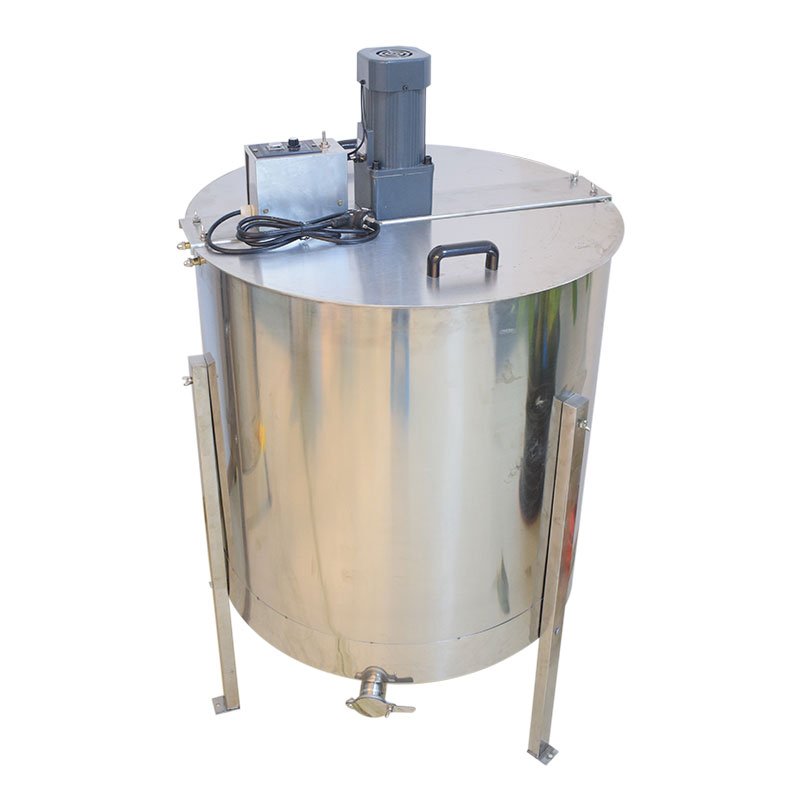
The table below sets out the structural difference. Cycle time is deliberately given as a range: honey viscosity, ambient temperature and how aggressively you are willing to ramp all move it, and no honest supplier should quote a single number without first asking what your honey is like.
| Factor | Tangential | Radial |
|---|---|---|
| Frame orientation | Broad face parallel to drum wall | Edge-on, like wheel spokes, top bar outward |
| Sides emptied per cycle | One | Two |
| Frame flipping | Required, mid-cycle | Not required |
| Drum diameter for a given capacity | Smaller | Larger, because radius drives the geometry |
| Comb support | Wall or mesh backs the wax | Comb unsupported; relies on wire and foundation |
| Operator hands-on time per load | High | Low |
| Deep brood frames | Handled safely | Blow-out risk rises with frame depth |
| Foundationless or natural comb | Handled safely | Poor; expect losses |
| Floor space | Compact | Large; needs a dedicated honey room |
One practical note on motor sizing. The force at the comb scales with rotational speed squared multiplied by radius, so a larger drum reaches the same force at a lower shaft speed. Big radial drums are therefore not the power-hungry machines people assume. What does grow is the torque required to bring a heavy, unevenly loaded basket up to speed — specify motor and drive together, and ask what happens on a deliberately unbalanced load.
Where tangential still wins
Radial is the right answer for most commercial honey supers, but it is not universal. Four situations favour tangential, and a distributor stocking only radial drums will lose those customers.
Deep frames used for honey. A deep Langstroth frame carries roughly 230 mm of comb depth on a 480 mm top bar, and a full one is heavy. Spun unsupported in a radial basket, that mass will tear out of the frame if the ramp is too aggressive. Operations running Dadant-format deeps for extraction in parts of Europe should think hard before committing to radial.
Foundationless or natural comb. Without a foundation sheet the comb has no internal reinforcement. It needs the backing a tangential wall gives it.
Very dense honey. Thick honey resists flow, and the direct outward pull of a tangential cycle moves it more decisively. Heather, manuka and some late-season blends fall into this group.
Small or mobile setups. A two- or three-frame tangential drum fits through a doorway and into a van. A radial drum of genuinely useful capacity does not. If your extraction is done from a truck at scattered yards, that constraint decides the question for you.
Viscosity and temperature: the variable nobody specifies
Two operations running identical machines on identical flows can get very different results, and temperature is usually why. Warm honey flows; cold honey does not. A drum loaded with frames at 30°C will empty in a fraction of the time the same frames take at 18°C, and the difference is larger for dense honeys than for light ones.
This is not a machine defect, but it is a specification issue, because it determines how much capacity you actually need. Commercial honey houses solve it with a warm room — typically holding frames overnight before extraction — rather than by buying a bigger machine. If you are sizing equipment for a customer, ask whether they have a warm room. If they do not, size for the cold case.
It also argues for variable speed control as a non-negotiable spec. A fixed-speed machine forces you to choose between comb damage and incomplete extraction, and the right answer changes with honey type, temperature and comb age.
Cleaning: the cost that shows up in year two
Radial baskets have more corners, more edges and more weld points than a simple tangential drum. End-of-season cleaning takes longer and needs more care. That is a real cost, it is recurring, and it is rarely in the purchase decision.
Two design details reduce it substantially. Ask for smooth, passivated internal welds rather than bright but rough ones, and ask for a sump and gate arrangement that drains completely. Residual honey in a sump ferments and will taint the first run of the following season — a common and entirely avoidable complaint.
Any surface that touches honey should be food-contact grade and documented as such. In practice that means 304 stainless for the drum, lid, basket and gate, with the grade stated in writing on the quotation rather than implied by a photograph. Honey is acidic, hygroscopic and hostile to anything that leaves it a place to sit; the USDA Agricultural Research Service publishes the underlying bee and honey management research that most commercial handling guidance is built on.
Sizing the drum to the flow, not to the hive count
Buyers routinely ask how many hives a 12-frame machine covers. The better question is how many frames arrive in a single working day at peak flow, because harvest is compressed. In a strong flow a colony can fill a super in under a week; the bottleneck is not the season, it is the week.
Work it backwards:
- Estimate how many supers you expect to pull in your heaviest week.
- Multiply by frames per super — 8, 9 or 10 depending on your standard.
- Divide by the number of extraction days you can realistically staff in that week.
- That gives frames per day. Divide by a conservative number of loads per day; uncapping, cleanup and bottling all compete for the same hours.

The answer usually surprises people on the high side. An operation with “only” 60 colonies can still need a 12- to 18-frame drum if the flow is short and intense. Conversely, 200 colonies on a long gentle flow can be handled by something much smaller. Capacity follows the peak, never the average.
Global context matters because it shapes what your customers will ask for. FAOSTAT put world natural honey production at roughly 1.99 million tonnes in 2024, with China at about 444,800 tonnes and the United States around 60,960 tonnes while importing substantially more than it produces. Where production is concentrated and seasonal — which is most of the world — extraction capacity has to be bought for the peak week.
Replacement demand adds a second layer. The 2025–2026 US beekeeping survey recorded an estimated 39.9% annual managed colony loss, following a 2024–2025 season that was the highest on record. Operations rebuilding after losses buy frames, boxes and extraction capacity together, which is why distributors often see extractor demand lag Colony loss numbers by one season rather than move with them.
Reading a quotation: what the price hides
Two quotations for machines of the same nominal frame capacity can differ by a wide margin, and the gap is rarely explained by brand. It usually comes from four things that are easy to miss on a spec sheet.
Sheet thickness. A drum built from thinner stainless costs less and weighs less, and it will flex. Flex shows up as lid seal leakage and, over a few seasons, as fatigue cracking around the basket mounts. Ask for the thickness in millimetres on the quotation itself.
Grade of stainless. 304 is the standard for honey contact. Lower grades look identical in a photograph and corrode differently in service. If the quotation says only “stainless steel”, treat it as unspecified and ask again.
Drive and speed controller. A mechanical single-speed drive and a variable-frequency drive with a soft ramp are not comparable products, even on the same drum. The controller is where most of the price difference sits, and it is also where comb damage is prevented.
What is included. Legs, lid, gate, basket, spares kit and carton are separate line items in some quotations and bundled in others. Compare delivered cost per complete, usable machine, not the headline unit price.
For importers, add freight realism to the same calculation. A 24-frame radial drum is bulky and heavy; the ocean freight on one machine can exceed the cost of a small tangential unit. Get carton dimensions and gross weight before you compare, and get a stated container loading quantity so you can spread the freight across the order.
Installation: the three things that fail after delivery
Machines do not usually fail in the drum. They fail in the room around it.
- Floor and levelling. A large drum on an uneven floor walks and loads the bearings unevenly. A level, solid floor with the machine bolted down is not optional at commercial capacity.
- Drainage. The honey gate needs somewhere to discharge, and the floor needs to be washable and drained. Honey houses built without a floor drain are a recurring and avoidable problem.
- Power. Confirm voltage, frequency and current draw against your supply before the container ships, not after. On three-phase machines, also confirm phase rotation at commissioning — a reversed phase will run the drum backwards, which on some basket designs damages frames.
None of these are exotic. They are simply the items that get skipped when the purchase decision is made on frame count and price alone.
Warranty, spares and what happens when it stops
Extraction equipment fails during harvest, not in the off-season. A machine down in the middle of a three-week flow costs the crop, not the machine, so treat after-sales as a specification rather than a courtesy.
Ask four questions before ordering. Which parts are consumable and which are structural? What is the lead time on a replacement drive belt, gate seal or bearing set? Is the warranty stated in writing with a defined response time, or is it a sentence on a website? And does the supplier stock spares in your region, or does everything ship from origin?
For distributors the same questions become a product decision, because your customers will ask you, not the factory. Holding a small spares buffer — belts, gate seals, bearings, lid latches — costs very little and is often the difference between keeping and losing a commercial account.
One more thing worth writing into the purchase order: commissioning documentation. A machine that arrives with no ramp-up procedure, no torque settings and no cleaning schedule will be run badly, and the manufacturer will be blamed for it.
Specification checklist for an import order
When you specify machines for a container order, these are the items that separate a usable machine from a problem. Most are cheap to get right at the factory and expensive to fix afterwards.
| Specification | What to ask for | Why it matters |
|---|---|---|
| Drum material | 304 stainless on all honey-contact surfaces, grade stated in writing | Honey is mildly acidic and often warm; lower grades stain and pit |
| Sheet thickness | Declared in mm on the quote, for drum and lid | Thin drums flex under load and distort the lid seal |
| Frame basket | Confirmed frame standard — Langstroth, Dadant, National — and frame depth | A basket cut for the wrong depth is unusable, and this is the single most common cause of returns |
| Honey gate | Full-bore food-grade valve positioned to drain completely | Residual honey ferments and taints the next run |
| Motor and drive | Voltage and frequency for the destination market, plus stated duty cycle | A 50 Hz motor on 60 Hz supply runs wrong; continuous harvest duty differs from intermittent |
| Speed control | Variable, with a soft ramp | Hard starts are the main cause of comb blow-out |
| Lid and interlock | Latching lid with an interlock that stops rotation when opened | Required by most commercial insurers and many workplace safety rules |
| Welds and finish | Smooth passivated internal welds | Crevices hold honey and are difficult to sanitise |
| Spares | Belt, gate seal and bearings quoted with the machine | A machine down mid-flow costs more than the spares ever will |
If you are buying to resell, add three more: carton dimensions and gross weight so you can cost your own freight, a stated container loading quantity, and written confirmation that the basket matches the frame standard your market actually uses.
What a distributor should actually stock
The mistake is stocking one type. Your customer base splits by frame standard and by honey type, and a range that covers only the most common case leaves money on the table. A workable starting mix looks like this:
| Customer type | What they buy | Why |
|---|---|---|
| Hobby and first-season | 2–3 frame manual or small tangential | Price-led, space-constrained, low annual frame count |
| Sideliner, 20–80 colonies | 4–6 frame electric, tangential or small radial | First step out of manual; often still running mixed frame depths |
| Commercial, 100+ colonies | 12–24 frame radial, variable speed | Throughput-driven; buys on frames per hour and uptime |
| Deep-frame and foundationless operators | Reversible tangential | Comb support is the deciding factor, not speed |
Questions buyers ask
Is a radial extractor always faster?
Not in spin time. It is faster in operator time, because there is no flip step. The cycle itself can run the same length or longer.
Can I run deep brood frames in a radial drum?
Sometimes, with a gentle ramp and strong wired comb, but the risk of comb blow-out is real. If deep frames are your main extraction format, tangential is the safer specification.
Do I need three-phase power for a large radial machine?
Not necessarily. Many mid-size radial drums run on single-phase with a variable speed drive. Confirm the motor rating and the duty cycle against your supply before ordering, and state your market’s voltage and frequency on the purchase order.
What is the single most common specification error?
Ordering a basket cut for the wrong frame standard or depth. It is cheap to get right at the quotation stage and effectively impossible to fix after the container lands.
Before you place the order
Write down four things and send them with the enquiry: your frame standard and depth, the number of frames you must clear in your busiest extraction day, your supply voltage and frequency, and whether any of your honey is dense enough to need a tangential cycle. A manufacturer who quotes without asking those questions is guessing, and you will be the one who pays for the guess.
For operations on standard medium or shallow supers with wired foundation, a radial drum sized to the peak week is nearly always correct — the honey extractor range covers that workflow from 2 to 24 frames. If you handle deep or fragile comb, a machine like the 3-frame manual stainless extractor protects the comb even though it costs more operator time. Crews stepping up from hobby scale usually land on a 4-frame electric unit with variable speed control, and continuous extraction operations should look at the 24-frame radial electric extractor. Extraction is only half the line — the strainers, pails and holding tanks decide how fast you can get it into a bottle.