

A mating nuc is a production unit, and the way it is designed sets the ceiling on how many saleable queens an operation can produce per season. Too small and the queen mates poorly or not at all; too large and the bees, the syrup and the labour eat the margin. The decision is not about which box is nicest to open. It is about bees per unit, loss rate, and how many units a crew can service in a day.
Queen banking sits on the other side of the same planning problem. A producer who banks queens is holding inventory against a demand curve that peaks in spring and again in late summer, and the number of queens per bank, the storage temperature and the storage duration all change the survival figure. The research on this is recent and specific, and it is worth reading before choosing a stocking rate.
What a mating nuc has to do
The box has three jobs. It has to hold a queen through emergence, mating flights and the start of laying. It has to hold enough workers to keep the brood warm and feed the queen, with no foragers of its own worth speaking of. And it has to be cheap enough per unit that a producer can run hundreds of them.
The second job is where designs diverge. A mini nuc of the Apidea class needs only about a mug-full of bees to stock, which is why commercial queen producers use them: the bees saved per unit can be put into more units. A mating nuc built on three or four full-size frames needs two frames of emerging brood and one frame of food, with the bees attached, and it produces a queen that takes longer to mate and longer to start laying but is better mated and longer lived. That trade-off is stated plainly in published small-scale queen rearing guidance, which also notes that queens mated in mini-hives are often superseded later in the same season.
Four design classes and where each fits
Mating nucs cluster into four size classes. The columns below describe function, not a standard — dimensions vary by manufacturer, so ask for a measured specification sheet rather than working from a catalogue photograph.
| Design class | Typical build | Bees to stock | Where it fits |
|---|---|---|---|
| Mini-plus (Apidea class) | Polystyrene box, 3–4 mini frames, integral feeder | About a mug-full | High-volume commercial mating; mating yards moved by vehicle |
| Mini foam box | EPS shell, one to two mini frames, excluder and feed board | Low; varies by model | Entry-level and short-season rearing; cheap per unit |
| Half / three-quarter frame nuc | Wooden or plastic box on shortened frames | Intermediate | Producers wanting mating quality closer to full-size without the bee cost |
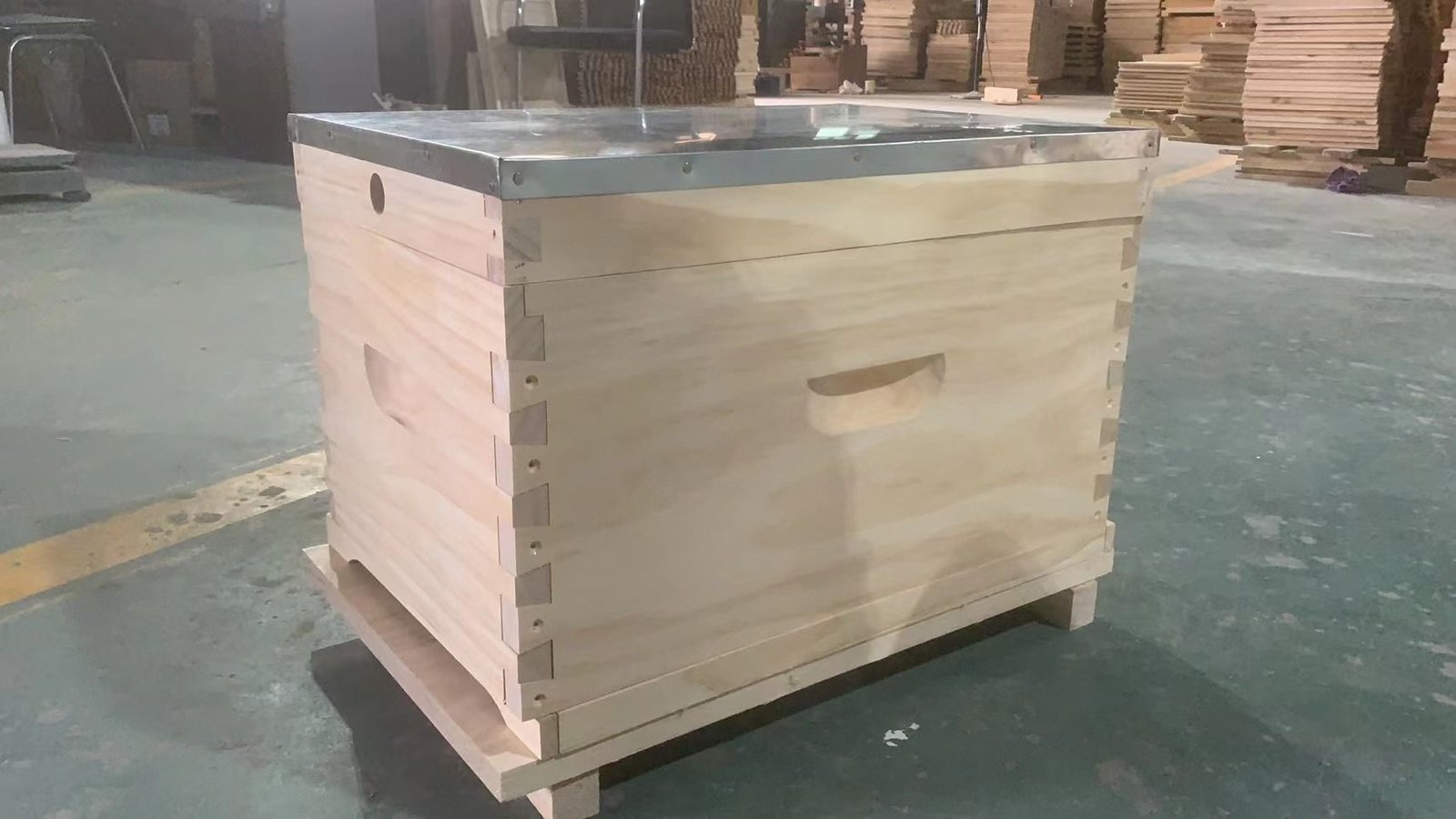
| Full-frame mating nuc | Three or four full-size frames in a standard box | Two frames of emerging brood plus one of food, bees attached | Breeding stock and nucleus production where queen longevity matters more than unit count |
Material choice follows climate and logistics rather than preference. Polystyrene holds temperature with less thermal mass than wood, and the insulation advantage varies by wall thickness and manufacturer — ask for a measured figure rather than accepting a marketing multiple. Polystyrene is lighter to carry across a mating yard and cheaper to ship per unit of volume, which matters when the order is several hundred units. Wooden units take more space in a container but survive being stacked, dropped and pressure-washed.
Three hardware details decide whether a design works in the field. The feeder has to be refillable without opening the brood chamber, because opening a mini nuc in cool weather costs brood. The entrance needs a disc or shutter that closes for transport and opens at the mating site, and it needs to close against robbing. And the internal volume has to accept a mini frame that is interchangeable across the fleet — a producer running two frame sizes across one yard will lose more time to mismatching than to any other single cause.
Timing: from cell to laying queen
The schedule is fixed by queen biology, and it is the same for every box design. A virgin needs about three days after emergence for her integument to harden enough to fly, then another three or four days for mating flights. Inspection at ten days is the first point at which eggs confirm a successful mating.
Losses in that window are normal. Field guidance for mini mating nucs puts the failure rate at roughly 25 percent of queens not returning from mating flights, which is why four-chambered mini nucs are built to tolerate one lost chamber. The COLOSS standard methods for queen rearing give complementary figures: under well managed conditions at least 80 percent of grafted larvae should be accepted, and acceptance of virgin queens introduced to a mating box can exceed 85 percent. Queen cells should go into the mating box at least one day before emergence, and introducing two cells rather than one avoids the case where a cell fails or a queen is destroyed by the bees.
Where an incubator is used, the COLOSS methods specify 34.5 °C and 70 percent relative humidity for sealed queen cells. That number matters for procurement because it defines what “incubator-ready” has to mean: a box that will hold a ripe cell must sit in that range without cooking the bees once it is populated.
Queen banking: what the research shows
Banking means holding queens in individual cages inside a strong colony, or holding laying queens in small mating units, so that inventory exists when demand returns. Two published studies give usable survival figures, and they point in different directions on one variable: temperature.
The Washington State University work (Webb and colleagues, Journal of Apicultural Research, 2023) prepared 18 banks holding 50, 100 and 198 queens, and compared refrigerated indoor storage against conventional outdoor banking over six weeks. In the banks of 100, survival was 78 percent refrigerated against 62 percent outdoors. The authors note that commercial producers commonly run up to 200 queens per bank, that a bank of 100 queens is worth more than 5,000 US dollars, and that producers may hold ten to twenty banks at a time. The refrigerated banks also required less maintenance.
Canadian work gives the winter picture and the stocking-rate warning. Boudreau and Giovenazzo (2025) set up eight banks of 40 caged queens each in Quebec in September 2020, choosing 40 because earlier work indicated that more than 40 queens per bank can raise spring mortality. Over the winter storage period from 26 October 2020 to 1 May 2021, banked queen survival was 37 percent against 89 percent for control queens in nucleus colonies, with bank-level survival ranging from 11 to 70 percent. Surviving banked queens did not differ from controls in weight, ovary weight, sperm count, sperm viability, haemolymph protein or vitellogenin, but their colonies produced significantly less brood in the first month after introduction.
A separate Quebec study of indoor mass storage over winter (MDPI Agriculture, 2021) ran 15 banks holding 600 queens and found 85.5 ± 6.8 percent survival after 70 days outdoors, and 86.3 ± 4.1 percent survival at a storage temperature of 16 °C over a longer period, against 56.9 ± 4.6 percent at 6 °C and 55.5 ± 15.0 percent at 11 °C. Sperm viability averaged 80.3 ± 1.2 percent across groups with no significant difference. Introduction success seven to ten days after removal was 79, 94 and 88 percent for the 6, 11 and 16 °C groups respectively.
| Study | Queens per bank | Duration | Survival |
|---|---|---|---|
| WSU, outdoor, 6 weeks (2023) | 100 | 42 days | 62% |
| WSU, refrigerated, 6 weeks (2023) | 100 | 42 days | 78% |
| Quebec, outdoor, summer (2021) | 40 | 70 days | 85.5 ± 6.8% |
| Quebec, indoor 16 °C (2021) | 40 | 228 days | 86.3 ± 4.1% |
| Quebec, indoor 6 °C (2021) | 40 | 228 days | 56.9 ± 4.6% |
| Quebec, overwintered bank (2025) | 40 | 188 days | 37% (controls 89%) |
Two readings of that table matter for equipment planning. Summer banking at moderate temperatures is a mature technique with survival in the 78 to 86 percent range. Overwinter banking is a different proposition entirely: 37 percent survival against 89 percent for control colonies means a producer banking through winter needs roughly two and a half times the queen inventory of one who does not, and the spread between banks — 11 to 70 percent — says the technique is operator-dependent rather than equipment-dependent.
The 16 °C result against the 6 and 11 °C results is the other useful finding: colder is not better. A storage room specified at 6 °C will underperform one held near 16 °C by about 30 percentage points over a winter, which is a specification question for anyone building an indoor wintering facility rather than a beekeeping question.
Stocking rates and what they cost
The trade in queen banking is between units and survival. More queens per bank means fewer colonies tied up in storage, fewer cages, and less feeding labour — and a higher mortality figure. The WSU work ran banks at 50, 100 and 198 queens; the Canadian work settled on 40 on the basis of earlier evidence that above 40 the spring mortality rises.
Cage design is the equipment variable that sits underneath that. A banked queen is held in a cage with attendants, pinned to a frame inside a strong colony of workers who feed her through the mesh. The cage has to allow feeding through the screen, hold a candy or syrup reserve, and be removable one-handed by a worker wearing gloves. Cages are cheap per unit and consumable in practice, so they belong on the same order as the mating nucs rather than as an afterthought.
Feeding is the recurring cost the research keeps returning to. The WSU authors describe banking as an art requiring continual management, feeding and moving of resources; the refrigerated banks needed less of it. Any specification for a banking set-up should therefore include the feeder design and the syrup delivery route, not just the box.

Two hemispheres, two rearing windows
Queen rearing follows drone availability and weather, so the window moves with the calendar just as the honey flow does.
In the northern hemisphere, grafting typically begins once drones are flying and night temperatures stay above freezing — broadly April to July in temperate regions, with the bulk of mating in May and June. Banking runs through the summer, which is when the WSU refrigerated results apply, and the second demand peak comes in late summer when beekeepers replace lost queens after the flow.
In the southern hemisphere, the same sequence shifts six months. Australian colonies begin raising drones in August as the brood nest grows, queen cells and swarm preparations peak in October and November, and queen breeders supply queens from September through to the end of February. New Zealand runs a similar pattern, with the short mānuka bloom in November to January competing for labour and equipment. Equipment for the southern season has to be in the country by late July, which means the order goes in around April.
For a supplier the practical point is that mating nucs and cages are ordered twice a year by the two halves of the customer base, and that tooling for mini frames is a one-time cost that pays back across both seasons.
Stock selection and rearing method are covered in the USDA Agricultural Research Service’s bee research pages, and the ARS bee programme is the primary source for the genetics work behind varroa-sensitive hygiene lines. The Honey Bee Health Coalition publishes management guidance that covers the varroa side of queen production, and the FAO pollination pages set the wider context for queen demand.
What a mating nuc costs per mated queen
Unit prices vary by material, wall thickness, frame count, order quantity and finish, so the table below compares the cost drivers and the planning ratios rather than quoting a price. Where a landed unit cost is needed for a budget, ask the supplier for a quotation against the actual specification and container quantity.
| Design class | Units per 100 mated queens* | Bees per unit | Main cost drivers | Reuse and lifetime |
|---|---|---|---|---|
| Mini-plus (Apidea class) | About 135 | About a mug-full | Polystyrene mould tooling, feeder and shutter parts, frame count | Multi-season if handled; EPS cracks under UV and rough stacking |
| Mini foam box | About 135 | Low; varies by model | Lowest unit cost; highest shipping volume per unit | Consumable in commercial use |
| Half / three-quarter frame nuc | About 130 | Intermediate | Timber or plastic box, shortened frames, feeder | Long service life; repairable |
| Full-frame mating nuc | About 125 | Two brood frames plus one food frame, bees attached | Standard box and frames, no special tooling | Longest service life; doubles as a production nuc |
*Planning ratio, assuming roughly 25 percent of queens fail to return from mating flights and allowing a small cull for poor laying. Loss rate varies by weather, drone availability and mating yard isolation, so treat the ratio as a planning baseline and adjust after the first season of records.
The comparison that decides the purchase is bees, not boxes. A mini-plus unit needs a mug-full of bees where a full-frame unit needs two frames of brood with the bees attached, so the same bee population stocks several times more mini units. Against that, the full-frame unit produces a queen that is better mated and longer lived, and it doubles as a saleable nucleus. A producer selling mated queens in volume will run mini units; a producer selling breeding stock will run full-frame units; and a producer selling both will run both and keep the frame sizes separate.
Container economics then decide the order size. Polystyrene units nest and ship at a far lower cost per unit of volume than assembled wooden boxes, which changes the freight line on a large order more than the unit price does. Mixing mating nucs, mini frames, feeders and queen cages into one container spreads that freight across the whole rearing kit.
On the hardware side, a dedicated Apidea-type mating nuc covers the high-volume case, while a queen bee box handles holding and transport of caged queens between the rearing yard and the bank. Cages, cell cups and the grafting tools that feed them are the consumable side of the same order, and the full queen rearing and cage range is where those lines sit.

One closing note on specification. Whatever class is chosen, buy a single frame size and a single cage type for the whole fleet, and buy spare shutters and feeders at 10 percent of the unit count. The failures in a mating yard are almost never the box; they are the missing shutter, the cracked feeder, or the frame that does not fit the box it was carried to.