

Uncapping looks like the least consequential step in honey extraction. It is a blade drawn across a comb. But the tool chosen there decides three things downstream: how much wax ends up in the honey you have to filter, how much wax you get to sell, and how many frames leave the room with comb you intended to reuse.
This is written for buyers equipping a honey house and for distributors building an uncapping line out of stock parts. It sets the five hand tools and the automatic machines against each other on the things that are measurable, and says plainly where the numbers are missing.
What the operation actually has to achieve
Two objectives pull against each other. Every capped cell has to be opened or the honey stays behind, and the comb underneath has to survive so the colony does not have to rebuild it. Any tool that does the first at the expense of the second is expensive in a way that does not show up on the invoice.
Tools divide cleanly into two families by what they do to the wax. Cutting tools — heated knives, cold knives and planes — remove the cappings as a sheet. Perforating tools — rollers, scratchers and forks — open the cells but leave the wax broken up, mixed with honey, or still hanging on the frame. Almost every trade-off below follows from that one distinction.
The five uncapping tools compared
| Tool | Action on the cappings | What reaches the extractor | Power | Fit |
|---|---|---|---|---|
| Heated electric knife | Melts through the capping, removing it as a continuous sheet | Least wax debris of any option; shortest filtering step | Mains electricity, and a thermostat or dial on better units | The volume default from a few dozen colonies upward |
| Cold serrated knife | Saws through the capping at whatever depth the wrist sets | Clean if the cut is shallow, torn if it is not | None | Remote rooms, no-power sites, operators prioritising control |
| Scratcher or uncapping fork | Rakes the capping off, shredding it | Most wax fines of any tool; needs real straining | None | Second tool at every station, for low spots no blade reaches |
| Spiked roller | Punches holes; the capping largely stays on the frame | Wax pieces rather than fines, plus some honey left in missed cells | None | Fast manual work where beeswax recovery is not the priority |
| Uncapping plane | Shaves the face at a fixed, adjustable depth, like a wood plane | Sheet cappings, with the cut depth held mechanically | Mains electricity | Uneven comb, framed-deep variation, operators chasing consistency |
The fork’s position in that table surprises people who have only used it as a backup. It is genuinely the slowest way to uncap a full frame and it produces the dirtiest honey, which is why it belongs at every station as the tool that catches what the blade missed rather than as anyone’s primary method. Every source agrees on that: the blade takes the flat areas and the fork gets into the dips near the frame edges and foundation wires.
The roller deserves the opposite warning. Because it leaves most of the wax attached to the comb, operators collect noticeably less beeswax, and practitioner reports add a condition that matters for anyone buying one: perforated comb is reported to release cleanly in a radial extractor and less cleanly in a tangential one. That is workshop reporting rather than a tested result, and it should be checked against your own extractor before the roller becomes your house method.
The plane is the least discussed of the five and the easiest to specify badly. Its defining feature is an adjustable blade set to a chosen depth, so the tool rides over the comb face rather than being steered through it by hand. That is what makes it suited to uneven comb, where a fixed blade either misses the low spots or gouges the high ones. Published cut-depth figures exist per model and not more widely; treat any “set it to X millimetres” advice as model-specific and ask the supplier for the adjustment range.
Heat: how much, and what it costs you
Beeswax does not have one melting point. FAO’s beeswax bulletin is quoted in industry writing as giving a melting range of 48 to 68 °C, which reflects differences in wax composition and cleanliness rather than imprecision in the measurement. In practice operators run heated blades just above the point where the capping releases, and advice for adjustable models commonly lands around 63 to 66 °C; there is no single setting that suits every knife, and it is worth being blunt that some published figures circulated for electric knives are not universal requirements. Follow the tool maker’s instruction for that tool.
The failure mode with heat is not the temperature, it is the dwell. A heated blade held still against the comb overheats the wax and the honey behind it. Overheating drives hydroxymethylfurfural up, and the Codex honey standard sets compositional criteria including limits for HMF that apply to honey placed on sale; check the current text for the limits that apply in your market. The operator rule that prevents it is simple and should be posted above the bench: keep the blade moving, lift it off the comb between strokes, and rest it on a heat-proof support rather than in the pile of cappings.
Automatic machines handle this differently, because the circuit controls the blade rather than the wrist.

What powered machines publish
Buyers comparing automatic uncapping machines are comparing published numbers, and those numbers are quoted truthfully but not always read carefully. The figures below come from three machines currently on the market; they are supplier specifications, not test results, and they are given so you can see which specifications exist to be compared.
| Specification | Unit | Published figures seen across current machines | What to check before buying |
|---|---|---|---|
| Throughput | Frames per hour | Around 180 frames/hour on one design, near 200 frames/hour on another, about 4 frames per minute on a third | Whether the figure is quoted on uniform comb, and whether it includes loading time |
| Comb thickness acceptance | mm | One unit publishes an adjustable window of 22 to 45 mm | Compare against the comb your own frames actually produce at your own spacing |
| Blade temperature control | °C | One control circuit is adjustable from 30 to 95 °C | Whether this is the circuit setting or a measured blade temperature |
| Heating power | W | 400 W per knife pair with a 24 V supply on one design; 1,800 W heating element with a circulation pump on another | Supply voltage and phase available in your honey house |
| Heat-up time | minutes | About 5 minutes to working temperature on one unit | Whether it is from cold start or from standby |
| Automatic extractor cycle | Frames per hour | A compact automatic 4/8 frame extractor publishes 35 to 50 frames per hour with seven programmes | Whether the machine self-balances and what it does on an out-of-balance load |
The line worth reading twice is comb thickness acceptance. A machine that accepts 22 to 45 mm of comb will cope with most well-managed frames and will struggle with comb built either very fat or very thin, and comb geometry is created upstream by frame spacing and foundation choice months before the frames reach the machine. It is the same problem from the other end of the building.
The cappings stream is where the money is
Cappings are not waste. FAO’s beeswax bulletin describes wax rendered from cappings as very high quality and light coloured, ahead of light-coloured broken comb and well ahead of old dark brood comb. Where a honey house separates its wax streams, the cappings are the premium one.
Quantity is small and easy to get wrong. FAO’s bulletin puts wax yield in frame-hive beekeeping at only 1 to 2 percent of the honey crop, against 10 to 15 percent where whole combs are crushed in top-bar and traditional hives. A commonly used planning estimate is about 1.5 kg of wax per 100 kg of honey, and suppliers publish it with the right caveat: it is a planning guide, not a guaranteed yield, because cutting depth and recovery method change what you actually collect. Two further details matter commercially. Freshly cleaned wax can hold up to 20 percent water, so blocks should settle before being weighed for sale or for a formulation. And whichever tool you use, some of the crop stays in the cappings.
| Method | Where the wax goes | Where the honey goes | Downstream work created |
|---|---|---|---|
| Heated knife or plane | Removed as sheet, cleanly separated for rendering | Mostly reaches the extractor | Least straining; a single drain step for the sheet cappings |
| Cold knife | Removed as sheet if the cut is shallow | Reaches the extractor | A drain step, plus knife sharpening and dipping |
| Fork or scratcher | Broken into fines suspended in the honey | Reaches the extractor with debris | Heaviest straining load of the five |
| Roller | Mostly left attached to the comb | Some honey stays behind in missed cells | Least wax to process, which may or may not suit your revenue model |
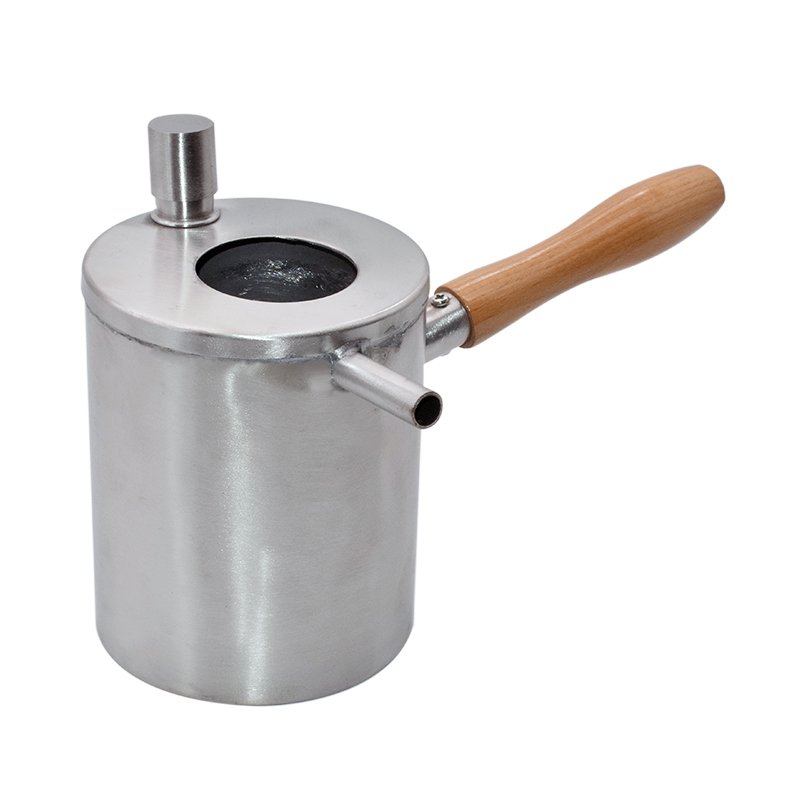
Recovering the honey in the cappings is a separate decision from uncapping, and it is worth more than most operators assume. Draining over a food-grade screen is the baseline; a cappings press recovers more of what draining leaves; a purpose-built melter separates wax and honey with heat and belongs higher up the volume curve. Tools for that step include a stainless steel wax press and a stainless steel wax melting pot. One caution worth repeating: honey recovered through melting should be assessed on its own before blending, and colour alone does not establish its condition.

Timing the purchase
The two hemispheres pull supers at different points, and the tool has to be in the room before them. In the northern hemisphere the main extraction runs roughly July through September across North America and Europe, so uncapping equipment decisions are made from about February to May. In the southern hemisphere, harvest falls roughly December through March across Australia, New Zealand and much of southern South America, which puts the equipment decision around August to October.
In both cases the same three errors repeat: ordering the machine in the week the flow starts, fitting the uncapping table after the extractor rather than before it, and discovering a knife is on the wrong voltage. The whole tool set sits under one roof in the beekeeping tools category, which is also where replacement blades and second tools for the low spots come from.
Summary
Choose by what arrives at the extractor, not by the price of the handle. A cutting tool — heated knife for volume, cold knife for no-power sites, plane for uneven comb — removes the capping as a sheet and keeps both the filtering load and the comb damage low. A perforating tool — roller for speed where wax recovery is secondary, fork for the spots no blade reaches — leaves wax in the honey or on the frame and shifts work downstream.
Then check three things before ordering. Confirm the supply: voltage, phase, and whether the machine’s published value is a circuit setting or a measured blade temperature. Confirm the comb: compare the machine’s accepted thickness window against the comb your own frames actually produce at your own spacing. Confirm the cappings plan, because a cappings stream worth roughly 1 to 2 percent of the crop, at quality worth protecting, deserves a press or a melter in the order rather than a bucket in the corner.
Background worth having before you write the specification: the Codex list of standards carries the honey standard that governs composition criteria, colony numbers and management practice from the US national beekeeping survey, honey bee research from the USDA Agricultural Research Service, and apiculture context from FAO’s pollination programme.