

A frame standard tells you the nominal number. It does not tell you what you bought. Thirty-five millimetres centre to centre is the figure every Langstroth catalogue quotes, and it is also the figure that hides the only thing that matters at scale: how far the frames you receive sit from that number, in the same direction, across an entire box.
This is written for operations moving into powered uncapping and automated extraction, and for distributors supplying them. It covers where the standard dimensions come from, how small dimensional errors accumulate across a box, what a machine at the interface actually accepts, and the tolerance budget worth writing into a purchase order.
The reference dimensions, and where each one comes from
Three numbers carry the whole system, and each has a different kind of authority behind it.
| Dimension | Reference value | Source and standing |
|---|---|---|
| Comb centre to centre, standard Hoffman frame pushed tight | 35 mm (1-3/8 in) | The nominal international Langstroth figure; produced automatically by pushing self-spacing frames together |
| Comb spacing range across European honey bee races | About 35 mm, within a range of 32 to 38 mm | Eva Crane’s reference work on world beekeeping, cited in turn by a 2018 review of hive dimensions; African races quoted nearer 32 mm |
| Bee space between comb faces | 1/4 to 3/8 in (about 6 to 9.5 mm) | The classic figure; below about 6 mm bees fill the gap with propolis, above about 9.5 mm they draw burr and brace comb |
| Ripe honey comb thickness | Roughly 22 to 25 mm on standard frames; fatter in wide-spaced supers | Practitioner convention; see the machine acceptance ranges below for the engineering version |
| Internal width of a standard 10-frame box | 14-3/4 in; ten frames occupy 13-3/4 in | Standard box geometry, leaving roughly one inch of slack to be parked at the walls |
The failure modes that bound those numbers were stated plainly in the review mentioned above, quoting the same 2018 work: where spacing is too small, bees cannot rear brood on both faces of the comb; where it is too large, they build burr or brace comb into the gap. Everything below is a consequence of drift away from the centre of that window.

Why 1 mm is not 1 mm of error
A single frame whose end bar is 1 mm wide is not a problem. Nothing a bee does is sensitive to 1 mm on one frame. The problem is that the error repeats, because frames come from one tooling set, one cutting run and one batch, and they all carry the same bias in the same direction.
Ten frames in a box, each 1 mm proud of nominal, consume 10 mm of the 25 mm of slack the box carries. That leaves the operator either jamming the last frame in or spreading the set across the gap — and spreading is what converts a dimensional problem into a biological one, because every gap larger than bee space gets filled with wax or resin. The table below is arithmetic on the nominal figures above, not measured field data; it exists to show the shape of the accumulation.
| Deviation per frame | Cumulative across 10 frames | Share of the box slack consumed | What it looks like in the hive |
|---|---|---|---|
| 0.1 mm | 1.0 mm | About 4 percent of 25 mm | Not detectable by eye; no management change needed |
| 0.3 mm | 3.0 mm | About 12 percent of 25 mm | Last frame goes in tight; operators begin leaving uneven gaps |
| 0.5 mm | 5.0 mm | About 20 percent of 25 mm | Visible variation in comb face spacing; low spots that a knife blade skips |
| 1.0 mm | 10.0 mm | About 40 percent of 25 mm | Ten no longer fit comfortably; operators drop to nine and the spacing exceeds bee space |
Two details make this worse than the arithmetic suggests. Wear and propolis add to the effective width of an end bar, so the same frame measures differently in its third season than on the day it arrived. And operator practice interacts with it: one common habit, running nine frames in a ten-frame super so the bees draw fatter comb that a knife can ride cleanly across, is perfectly sound on drawn comb and catastrophic on new foundation, because nine frames spread evenly across a ten-frame space is wide beyond bee space and produces exactly the bridged comb the standard exists to prevent.

Where the machine meets the frame
Everything above is tolerable with hand tools. A human uncapping by eye adjusts for every frame without noticing it does so. Machines do not, which is why tolerance stops being cosmetic the moment powered equipment enters the honey house.
The clearest published example is the adjustable range built into a mid-range automatic uncapping machine. One widely distributed European unit specifies an adjustable comb thickness range of 22 to 45 mm, with serrated oscillating knives adjusted to comb width, a heated knife circuit adjustable across 30 to 95 °C, a five-minute heat-up time, a stated capacity near 200 frames per hour and a 230 V single-phase supply. Similar machines quote approximately four frames per minute or around 180 frames per hour depending on design. Every one of those figures is a machine-side acceptance window, and every frame you send through has to fall inside it.
Comb built on frames spaced wide routinely exceeds 45 mm at the face. Comb built on frames cramped tight can sit below 22 mm. In both cases the machine either fails to reach the face with the knife, or drives the knife into the woodwork. Neither outcome is cheap, and neither is visible in a photograph of the comb.
The same logic governs the extractor. Cassettes and baskets are built to a frame standard with a designed clearance; put frames of a different tolerance through them and the symptoms are wear on one group of frames, imbalance loads, and jam clearance that gets slower each season. Where you know the fleet has dimensional variance, baskets should be measured against the actual frames rather than against the catalogue drawing.
Downstream, comb strength sets its own tolerance. Practitioner reporting on radial extractor work puts conventional spinning between about 200 and 400 rpm, with the careful operators starting near 60 to 80 rpm, taking off most of the honey at that low speed and only then ramping toward 300 to 350 rpm. Expressed as rim speed, one engineering treatment puts reliable extraction of capped comb at 120 to 250 rpm on a 600 to 750 mm drum, equivalent to 5 to 12 m/s at the rim, with soft or warm comb failing above roughly 15 m/s. These are not standards, they are operating practice, and they vary by machine. They are quoted here because they interact with comb built outside its intended thickness: thin comb built at tight spacing is exactly the comb that fails at any given rim speed.
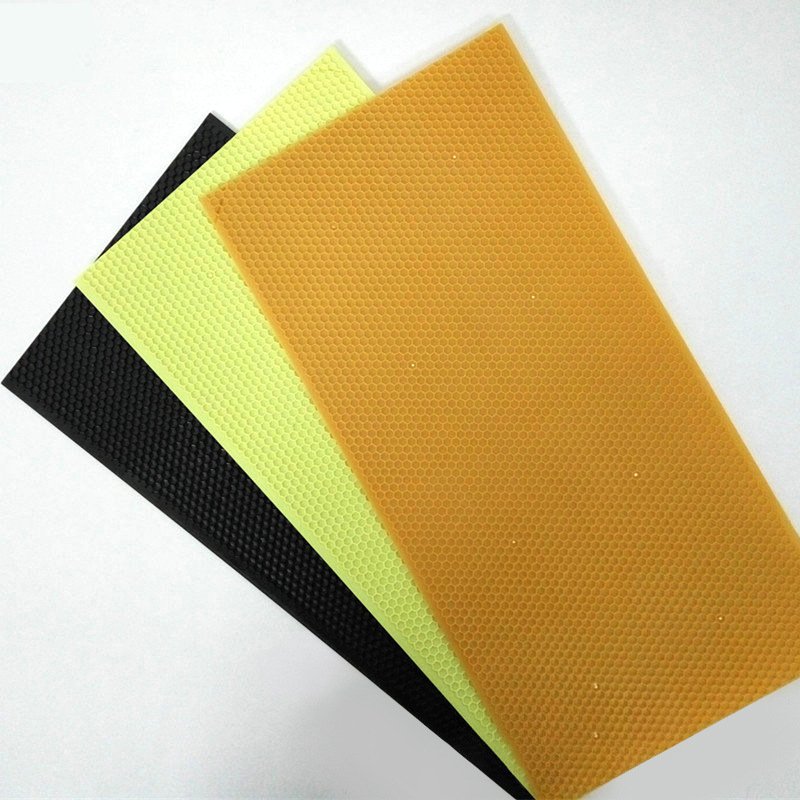
Frame choice is therefore the upstream decision. A standard wooden frame built to nominal tolerances keeps the whole chain inside its windows, and a frame with a plastic base plate changes the stiffness picture again, because the base sheet sets cell depth and comb attachment differently from wired wax foundation.
The tolerance worth specifying
A purchase order that restates the nominal dimensions is asking the supplier to agree with the catalogue. A purchase order that states a tolerance band is asking for something measurable. Four lines cover it.
End bar width with both limits. State the nominal in millimetres and permitted tolerance in both directions, and say where it is measured. One producible commercial specification is the nominal plus or minus 0.3 mm measured on finished goods, sampled per lot. Whether a given factory can hold that is a question for that factory, and the answer should come back as a number.
Flatness and twist. A frame within tolerance on width can still be out of tolerance on twist, and it is twist that makes frames bind in a cassette. Ask for a flatness tolerance over the length of the frame in the same band.
Sampling plan from a published standard. Rather than agreeing a sample size by negotiation, reference an accepted attribute sampling standard and name the acceptance quality limit for critical and major defects separately. Critical here means anything that stops the frame going through powered equipment; major means anything that changes spacing.
Interchangeability with existing stock. State that new deliveries must index interchangeously with a named reference frame already held in the yard, and send a physical reference. This is the clause that actually catches batch drift, because it is tested in the honey house rather than at the bench.
Moisture content belongs in the same document for wooden frames, for two reasons: it moves during shipment and it moves dimensions with it.
Seasonality: when the tolerance is created
Spacing errors are mostly created during drawing, not during manufacture, and drawing happens at a predictable point in each hemisphere.
In the northern hemisphere, new foundation is drawn during the main flow, broadly May through July across temperate North America and Europe, which means the frame purchase decision has to be settled in the preceding autumn or winter. Equipment ordered now lands for the following spring build-up.
In the southern hemisphere, the same window falls roughly September through December across Australia, New Zealand and southern South America, with orders placed around July to September. Supers are pulled for extraction through the late summer in both hemispheres, which is where the whole year’s tolerance mistakes surface in a single week.
The one rule that applies in both: draw new foundation at full frame count, pushed together. Nine frames in a ten-frame box is a technique for drawn comb in honey supers and nowhere else.
Mistakes that cost the most
| Mistake | How it shows up | What it costs |
|---|---|---|
| Specifying nominal dimensions without a tolerance band | Frames arrive within what the supplier considers reasonable; nobody can reject them | The order is accepted and the problem is discovered a year later in the honey house |
| Spreading nine frames across a ten-frame box during drawing | Fat, wavy and bridged comb that crosses frame boundaries | Frames cannot be removed cleanly, powered uncapping cannot index, and the comb has to be cut out |
| Buying frames from a second factory without sending a physical reference | Two populations in one yard that do not index interchangeably | Sorting labour every time a box is assembled, and growing cassette wear |
| Assuming comb thickness will sit inside the machine’s adjustable range | Knife either misses the face or cuts the frame | Direct machine downtime during the week that matters most; check the machine’s stated range before ordering frames |
| Ignoring extraction speed as part of the same tolerance problem | Blow-outs blamed on the extractor rather than on comb built thin | Lost comb and, far more expensive, lost time rebuilding drawn comb that bees had already paid for |
| Specifying tolerance but not the test method | Dispute where agreement should exist | A credit note argument instead of a measurement |
The common thread is that every one of these is decided before the frames arrive and discovered after they have been returned to a hive. Frame purchases repeat for years, so a tolerance negotiation conducted once, awkwardly, is cheaper than tolerance drift discovered annually.
The full frame and foundation range sits in one place for that reason, because frame standard, foundation type and the equipment downstream have to be specified together rather than separately. Start there, in the frame and foundation category, rather than from the machine catalogue.
Background reading worth having before the conversation with a supplier: colony numbers and operating practice from the US national beekeeping survey, bee biology and management research through the USDA Agricultural Research Service, and production context from FAO’s pollination programme.