
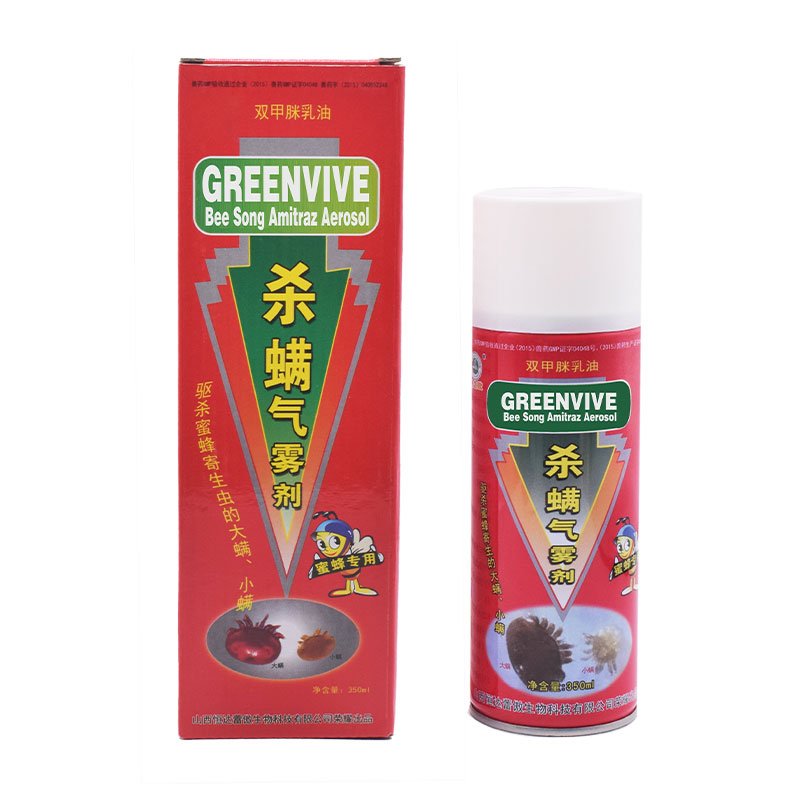
A miticide that has stopped working does not announce itself. The strips go in on schedule, the six or eight weeks pass, and the alcohol wash afterwards reads much the same as the wash before. For a commercial yard that is a full treatment cycle of product and labour spent for nothing, and in a bad year it is the difference between colonies that reach spring and colonies that do not.
The two active ingredients most often behind that outcome are tau-fluvalinate and amitraz. Both are still registered, both still work in plenty of places, and both have documented resistant mite populations on several continents. What keeps a treatment programme useful is not switching brand names. It is reading the mode-of-action information on the label, knowing which group each product belongs to, and rotating between groups rather than within a group.
This piece is written for buyers and distributors who supply commercial beekeepers, because resistance is now a procurement question as much as a husbandry one. A distributor who ships the same strip to the same customers every season is part of the selection pressure. One who can hand over a group-by-group rotation sheet with the order is selling something more durable.
What the mode-of-action group actually tells you
Mode of action is the biochemical route by which a compound kills. Two products can both be “synthetic strips”, look identical in the box, and share nothing at the target site. Two products can also be sold under different brand names and be the same chemistry, in which case alternating them buys nothing at all.
The reference framework is the IRAC mode-of-action classification, maintained by the Insecticide Resistance Action Committee. It assigns a group number to each chemistry by target site. Under that scheme the three synthetic varroa compounds sit in three separate groups:
| Active ingredient | IRAC group | Target site | What the mite experiences |
|---|---|---|---|
| Coumaphos | Group 1B (organophosphates) | Acetylcholinesterase | Nerve signalling blocked, hyperexcitation, death |
| Tau-fluvalinate, flumethrin, acrinathrin | Group 3A (pyrethroids) | Voltage-gated sodium channel | Channel stays open, prolonged depolarisation, paralysis |
| Amitraz | Group 19 (octopamine receptor agonists) | Octopamine receptor in the CNS | Overstimulation, tremors, the mite detaches and dies |
The practical rule follows directly from that table: a rotation is only a rotation if the group number changes. Moving from one pyrethroid strip to another pyrethroid strip is the same exposure repeated. Moving from a pyrethroid to an amidine, or from either to an organic acid, is a genuine change.
The organic acids and essential-oil products do not carry a numbered IRAC nerve-target group. Formic acid, oxalic acid, lactic acid, thymol and hop beta acids act by routes that are either non-specific or not fully described at a single receptor. That matters, because the European Medicines Agency’s reflection paper on resistance in ectoparasites records that, in contrast to the synthetics, no significant resistance is reported in Varroa destructor to the natural compounds classed as soft acaricides — thymol, oxalic acid and formic acid (citing Jack and Ellis, 2021, and Vilarem et al., 2021). Read that as: the acids are not a free pass, but they are the tools with no confirmed resistance liability today, and they are the reason a rotation can be built at all.
How each chemistry kills, and how each one fails
Understanding the failure route explains why rotation has to be planned rather than improvised.
Pyrethroids: tau-fluvalinate
Tau-fluvalinate binds the voltage-gated sodium channel in the mite and slows its gating kinetics. The channel stays open, sodium inactivation is prolonged, and the nervous system is held in a hyperstimulated state until the mite dies. This is the same target site that gives pyrethroids their knockdown speed in agriculture.
Resistance at this site is well characterised. Two mechanisms are documented. The first is target-site insensitivity: point mutations in the sodium channel gene, the best known being L925I, L925M and I1014F substitutions, which reduce how well the pyrethroid binds. The second is metabolic detoxification, with increased cytochrome P450 monooxygenase and glutathione S-transferase activity breaking the molecule down before it reaches the target. In Korea, molecular monitoring traced fluvalinate resistance to the rapid spread of the L925I/M mutations over roughly three years from 2021, with widespread resistance reported by 2022.
Formamidines: amitraz
Amitraz is a pro-pesticide. Inside the mite it is converted to N’-(2,4-dimethylphenyl)-N-methylformamidine (DPMF), which resembles octopamine and acts as an agonist at octopamine receptors. Overstimulation of those synapses produces tremors and convulsions; the mite loses grip and falls. Because the compound works by contact and is spread through the colony by the bees walking over the strip, it reaches mites riding on adults. It does not penetrate wax cappings, which is why the label period runs six to ten weeks — long enough to catch mite cohorts as they emerge from brood.
Resistance here is newer and regional. Published work links it to mutations in the β2-adrenergic-like octopamine receptor (Octβ2R): N87S in French populations, Y215H in populations from Spain and the United States, F290L and Y337F reported elsewhere, and a distinct T115N mutation in Korea. Metabolic resistance to amitraz in Varroa has not yet been reported, which is one reason molecular diagnostics are more informative here than synergist tests.
Organophosphates: coumaphos
Coumaphos is bioactivated inside the mite by cytochrome P450 monooxygenases into coumaphos-oxon, a much more potent inhibitor of acetylcholinesterase. Acetylcholine is not cleared at the synapse and the nervous system is held in hyperexcitation.
The resistance mechanism is less clearly established than for fluvalinate. Esterase-mediated detoxification has been implicated, and in other arthropods, reduced acetylcholinesterase sensitivity arising from mutations in the AChE gene is the common route. Either way, field failure is documented.
Where resistant populations have been reported
Resistance is not evenly distributed, and a distributor selling into several countries should not assume one answer covers all of them. The table summarises published reports by region and compound. Dates are the publication or detection year given in the source.
| Region | Compound | Reported | Note |
|---|---|---|---|
| Italy (Lombardy) | Pyrethroids (flumethrin, tau-fluvalinate) | Early 1990s | Spread along colony trade routes to Switzerland, Slovenia, France, Belgium, Austria |
| Germany / Finland | Pyrethroids | 1997 / 1998 | Traced to bee movement from Italy |
| United Kingdom | Pyrethroids | First cases confirmed 2001 | National Bee Unit surveillance programme; now considered widespread |
| Italy | Coumaphos | 2001 | First laboratory and field detection, northern Italy |
| United States | Pyrethroids and amitraz | 2000 onwards | Minnesota; amitraz-resistant populations confirmed in geographically distinct apiaries |
| United States (Florida) | Coumaphos | 2002 | Detected shortly after the product’s emergency introduction |
| Mexico | Pyrethroids and amitraz | 2005 | Multiple resistance in the same populations |
| Czech Republic | Acrinathrin, tau-fluvalinate, amitraz | 2016 | In vitro test methods |
| France | Amitraz and tau-fluvalinate | 2018–2019 survey | Mites collected from multiple apiaries |
| Spain | Coumaphos, tau-fluvalinate, amitraz | 2020–2021 | Large-scale monitoring across locations |
| Korea | Fluvalinate, then amitraz | 2022 / 2023–2024 | L925I/M sodium channel mutations then a decline in amitraz efficacy |
| Argentina | Multiple | 2018 | No reversion to susceptibility after nine years without use |
Two entries in that table deserve emphasis for anyone writing a specification.
Resistance does not reliably decay. Work in Argentina found no reversion to susceptibility after nine years of disuse. Some studies do report partial reversal of fluvalinate resistance after a period of no exposure, so the picture is not uniform, but the planning assumption should be that once resistance is established in a local mite population, that tool is gone for a long time rather than for a season.
Multiple resistance is common. USDA Agricultural Research Service survey work in 2003 found mites from five states resistant to fluvalinate, coumaphos and amitraz, with only a spring sample from Florida still susceptible. Populations carrying resistance to two or three groups at once are reported repeatedly. That is why rotation has to start before the failure, not after it, and why a programme built on a single synthetic is one bad season away from having nothing left.
How to read the label: the parts that carry the rotation instruction
Manufacturers do not print an IRAC group number on every varroa product, but the rotation instruction is on the label in plain language. Typical wording, drawn from registered product literature:
“Do not use for two consecutive treatment periods.” Apivar product directions state directly that the product should not be used for two consecutive treatment periods and recommend alternating with products from other chemical groups. If the label says this, the customer’s treatment record must show what was used last season, or the instruction cannot be followed.
“Must only be used once per year.” The Australian permit conditions for Apivar set a once-per-year limit, with the strips left in for six to ten weeks and removed after a maximum of ten weeks. The permit also specifies rotating with products of a different mode of action, explicitly not another amidine product.
Dose and strip count. Two strips per brood chamber, one per nucleus, hung within two frames of the edge of the cluster so bees can walk on both faces. Under-dosing is a resistance risk in its own right: a reduced number of strips means less contact and lower exposure, which is exactly the condition that selects for survivors.
Duration. Six to ten weeks in the hive, removed at ten weeks maximum, never reused. Pulling strips at four weeks because mite drop looked good leaves the later-emerging cohorts untouched and leaves the survivors as the breeding population.
Honey restrictions. Product labels are consistent: no honey supers on the hive during treatment, no honey harvested for human consumption while strips are in place, and brood frames from treated hives should not be reused as honey frames. New Zealand label text adds a 14-day no-collection period after strips come out; the Australian permit sets a zero-day withholding period after removal with the stronger condition that no honey is harvested while treatment is in place. Always work from the label registered in the country where the hive stands.
The generic principle that sits behind all of this is stated plainly in the Australian National Varroa Mite Management Program’s integrated pest management guidance: rotate chemical controls with different modes of action between seasons, keep records of every treatment, and do not respond to a poor result by raising the dose or the application frequency, because that accelerates resistance.
Building a rotation that holds up across a year
A rotation is a calendar matched to the colony’s brood state, not a list of products. Three rules cover most of the decisions.
Rule one: change group between treatment events, not between years only. The Honey Bee Health Coalition’s varroa guidance tells beekeepers to rotate chemical classes rather than swap brand names. Rotating once a year is the minimum; rotating at every treatment window is better, because each application is a selection event.
Rule two: never run the same group twice in a row. If amitraz went in last autumn, amitraz does not go in this spring. The mite generation exposed this season is the descendant of the survivors of the last one. This is the specific instruction printed on the amidine labels, and it is the one most often broken because it requires a written record.
Rule three: cap the number of synthetic exposures per year. Where the label states once per year, that is the cap. In programmes with no statutory cap, a working ceiling of one synthetic application per twelve months plus organic acid treatments in the remaining windows keeps the selection pressure low. The organic acid slots are what makes that ceiling survivable, because they carry no documented resistance liability.
Put together, a temperate-climate year looks like this: an organic acid or thymol treatment in the late-summer window when brood is still present, a synthetic from a single group in the post-harvest autumn window if monitoring says the threshold has been crossed, and an oxalic acid treatment in the broodless part of winter when phoretic mites are exposed. Next year, the synthetic slot is filled from a different group.
Seasonal windows: both hemispheres
Treatment timing follows brood state and temperature, so the calendar inverts between hemispheres. A distributor shipping to both should stock for both.
Northern hemisphere (North America, Europe, UK). The main synthetic or formic acid window runs from late July through September, timed after the last harvest and before the winter bee generation is raised. The broodless oxalic acid window falls November to January depending on latitude. In the UK and northern Europe, feeding and varroa work is finished by early September; leaving treatment until October is the common failure. Late winter, February to March, is the last monitoring check before spring build-up.
Southern hemisphere (Australia, New Zealand, southern South America). The equivalent windows shift by six months. Autumn treatment after the harvest runs March to May, with the Australian guidance placing the pre-winter inspection in April or early May at the latest. Winter, June to August, is the broodless period and the oxalic slot; colonies are left closed and stores are checked by hefting. Spring build-up starts August in New Zealand and September in Australia, which is when mite monitoring resumes in earnest.
For Australian buyers specifically, the operating context changed recently. The National Varroa Mite Management Program ran a two-year transition to management which concluded in February 2026, and the program’s published guidance now treats monitoring, treatment rotation and record-keeping as standing practice. Any supply conversation there should assume rotation is mandatory, not optional.
Where residues enter the picture
Resistance is a colony-survival problem. Residues are a market-access problem, and they are the part that reaches the buyer’s own customer. Both follow from the same choice of chemistry.
In the European Union, Commission Regulation (EU) No 37/2010 sets maximum residue limits for pharmacologically active substances in food of animal origin, honey included. The entries relevant to varroa control are sparse and worth knowing exactly:
| Substance | EU MRL in honey | Basis |
|---|---|---|
| Amitraz (sum of amitraz and all metabolites containing the 2,4-DMA moiety, expressed as amitraz) | 200 µg/kg | Regulation (EU) No 37/2010, Table I |
| Coumaphos | 100 µg/kg | Regulation (EU) No 37/2010, Table I |
| Tau-fluvalinate | No MRL required | Regulation (EU) No 37/2010, Table I |
| Flumethrin | No MRL required | Regulation (EU) No 37/2010, Table I |
| Formic acid, oxalic acid, lactic acid, thymol, eucalyptol, menthol, camphor | No MRL required | Regulation (EU) No 37/2010, Table I |
Two things follow. First, the two substances with a numeric limit are precisely the two with the worst resistance record, so the residue question and the resistance question push in the same direction. Second, “no MRL required” is not a licence — registration as a veterinary medicine by the competent national authority is still required before a product can legally be used, and national approval differs by country.
Wax is where residues persist. Coumaphos is lipophilic and accumulates in comb; published work in the United States recorded a US EPA tolerance of 100 mg/kg for coumaphos in beeswax, and found that wax held at that level transferred no more than 37 µg/kg into honey. Martel and co-workers measured honey residues below 100 µg/kg after 26 days of coumaphos treatment and estimated a half-life of 69 days in honey. Amitraz and its metabolites bind to beeswax as well, which is why labels forbid recycling brood frames into honey supers and why comb replacement schedules are part of residue control.
For a buyer, the practical residue checklist is short: buy only registered product with the national label in the destination language; confirm the withdrawal period in writing on the packing; and keep the treatment record for the minimum period the local rule requires. In Australia the permit conditions for amitraz require treatment records — date, location, amount used, operator — retained for two years from permit expiry. Austria and Slovenia require use records by statute. The European Commission’s honey sector page and the FAO pollination pages are the starting points for the residue and trade framework, and the World Organisation for Animal Health maintains the animal-health standards that movement and trade rules are built on.

What this means for the buying decision
If you are sourcing mite control product for resale or for a fleet of yards, four questions belong in the specification, and the answers belong in writing.
Which group is it? Ask for the active ingredient and its mode-of-action group on the quotation, not just the trade name. If a supplier cannot state the group, they cannot support a rotation.
What is registered where? Registration is national. A strip legal in one market is not automatically legal in another, and the label is the controlling document under pesticide law. The EPA’s pollinator protection pages set out the US framework; equivalent national authorities apply elsewhere.
What is the withholding period and the super rule? Get it from the label of the destination country. Do not reuse a figure from another market’s paperwork.
How will the customer record it? A rotation that is not written down is not a rotation. Printed treatment record cards, or a line on the invoice showing the group used last season, cost nothing and are the difference between a programme that works and one that quietly fails.
Monitoring sits underneath all of it. Any treatment decision should start and end with a count: an alcohol wash or sugar roll before treatment to establish whether the threshold has been crossed, and a second count after treatment to confirm the product worked. Equipment for that is inexpensive and should travel with the treatment order. Our Varroa Easy Check is the fast field method; the wider feeders and medicine range covers the treatment hardware.
On the synthetic side we supply tau-fluvalinate strips and flume-format fluvalinate strips, alongside the general miticide strip. We say the same thing to every buyer of these: order them as one slot in a rotation, not as the programme.
Bee health sits inside a wider trade and standards frame. The FAO pollination programme covers pollinator health at policy level, the World Organisation for Animal Health sets the animal-health standards behind movement rules, the EPA pollinator protection pages set out the US pesticide position, and the Honey Bee Health Coalition varroa guidance is the most usable operational reference for thresholds and rotation. The Australian national varroa integrated pest management guidance is the clearest published statement of the rotation obligation.
Key points to carry into next season
Group number first, brand name second. Tau-fluvalinate is IRAC 3A, amitraz is IRAC 19, coumaphos is IRAC 1B. A rotation only counts when the number changes.
Resistance is regional and long-lived. Pyrethroid resistance is documented from the early 1990s in Lombardy onward, confirmed in the UK by 2001 and now widespread; coumaphos resistance from 2001 in Italy and 2002 in Florida; amitraz resistance confirmed in the United States, France, Spain, the Czech Republic and Korea. Once present, it does not reliably go away.
The label already contains the rotation rule. “Not for two consecutive treatment periods”, “once per year”, six-to-ten-week duration, full strip count, no supers during treatment. Follow the registered label of the country where the hive stands.
Residues and resistance point the same way. Under EU Regulation 37/2010, the two compounds with a numeric MRL in honey are amitraz at 200 µg/kg and coumaphos at 100 µg/kg. Both are also the two with established resistance. Comb carries residues forward, so brood frames from treated hives stay out of the honey supers.
Count before and after. A treatment without a follow-up count is an assumption. The follow-up count is also how resistance is detected early enough to matter.
Plan the calendar for the hemisphere you ship to. Northern: treat July to September, oxalic in the broodless November-to-January window. Southern: treat March to May, oxalic across the June-to-August winter. Stock and documentation should match both.