

A colony that goes into winter looking strong and comes out weak is the classic Nosema picture, and it is also the classic Varroa picture, a poor queen, and a food shortage. Feeding more syrup to all four problems costs money and fixes one of them. A spore count separates them, and it is cheap enough to run on a schedule.
Nosema sampling is not a diagnostic curiosity. It is the input to an autumn and spring feeding decision on a commercial operation: how much syrup, what concentration, whether medication is justified, and which apiaries get the treatment budget. The US beekeeping survey co-ordinated by the Apiary Inspectors of America recorded an estimated 39.9% annual loss of managed colonies over the period April 2025 to April 2026, with commercial operations at 38.7% and a running 15-year average of 42.3%. At loss rates in that range, a gut parasite that shortens worker life is worth counting rather than guessing at.
Why the count, and not the symptom
Nosema apis and Nosema ceranae are microsporidian parasites that live in the midgut epithelium of adult bees. They damage the gut lining, interfere with nutrient uptake and shorten the life of the worker. The visible signs are unreliable in both directions. Dysentery streaking on the hive front is associated with N. apis, and much of what is read as dysentery is actually poor winter stores.
Nosema ceranae has been the dominant species in most regions since the late 1990s and shows no external symptom at all. It runs year-round. A colony carrying it looks normal until it stops building. Spring dwindling, a queen that has stopped laying, and poor build-up on the first flow all point at Nosema, and all point at three other things too.
The USDA Agricultural Research Service maintains reference material on Nosema disease and on the laboratory methods used to confirm it. Species identification needs molecular methods; a microscope count does not tell you which species you have, and that matters because the two behave differently through the year.
The sampling protocol
Provincial and state guidance converges on a narrow range of numbers. Alberta’s apiculture programme calls for 30 to 50 older bees taken per hive in spring and autumn from frames of honey, not young bees from the brood nest, because spore load builds with age and a young sample understates the colony. Take them from the entrance or the top bars if that is easier on a large run. Freeze the sample if it cannot be counted the same day; spore counts hold in frozen samples, which lets an operation batch a day’s sampling into one counting session.
Pool the sample rather than counting bees individually. A colony-level average is the number that drives a management decision.
| Step | Standard method | Notes for a commercial run |
|---|---|---|
| Bees per sample | 30 to 50 older foragers | Do not sample nurse bees from the brood nest |
| Dilution | Abdomens of 30 bees macerated in 15 ml of water | 0.5 ml per bee; keep the ratio identical every time |
| Counting | Haemocytometer at ×400, five blocks of 16 squares | Count spores touching the top and left lines only, not bottom and right |
| Calculation (Alberta method) | Total counted in five blocks × 25,000 | Gives spores per bee directly |
| Calculation (Cantwell 1970) | (Total of five blocks ÷ 80) × 4,000,000 | The older published formula; cited in North American guidance |
| Frequency | At least three times per year: spring, mid-summer, autumn | Add a count whenever a colony underperforms on a flow |
The exact arithmetic matters less than keeping it identical. A change in dilution ratio or in which blocks you count turns a trend line into noise, and the trend is the useful part of the data.
What the numbers mean
The conventional North American threshold is one million spores per bee. Alberta’s guidance is to treat with fumagillin when the average count exceeds that figure. Published extension material in New South Wales describes the same figure as a rule of thumb rather than a researched safe level, and adds the qualification that matters most: a low count at the start of winter is more serious than the same count at the end of it.
| Spores per bee | Reading | Action in most operations |
|---|---|---|
| Below 1,000,000 | Background level; many colonies carry Nosema without measurable loss | No treatment; feed to the season and re-count at the next window |
| Around 1,000,000 | The conventional action threshold used across North America | Treat per label where fumagillin is registered; the threshold was derived from N. apis |
| Above 1,000,000 in autumn | Reduced ability of the colony to survive winter | Prioritise these apiaries for autumn feeding and treatment budget |
| Above 12,000,000 in spring | Not uncommon for N. apis at its spring peak | Treat, requeen where the queen has failed, and check stores and mite load |
| Up to 40,000,000 | Documented, possibly associated with N. ceranae | Expect short-lived workers and slow build-up; plan for several generations of recovery |
One caveat belongs on the same page as the threshold. A two-year study of Nosema epidemiology in the Canadian prairies, published in PLOS ONE in 2021, describes the one million figure as a nominal threshold established for N. apis infections that has not been properly validated for either species under different winter management and climate conditions. N. apis has a documented seasonal pattern: highest spore abundance in spring, lower in summer, a smaller autumn peak, then a slow rise over winter in outdoor-wintered colonies. N. ceranae seasonality is described as highly variable and difficult to predict. Treat the number as a decision aid with a known weakness, not as a standard.
How the count changes the feeding plan
Feeding is where a count earns its cost. Four decisions follow from it.
Syrup concentration follows the season and the diagnosis. In a northern-hemisphere autumn the standard feeding mix is 2 parts sugar to 1 part water by weight. Thin 1:1 syrup in cold, damp weather adds moisture to the nest that the bees have to evaporate, and damp is what N. ceranae favours. A thick syrup also means less water for the bees to shift before they can cap it. Where a medicated feed is used, follow the label concentration rather than the seasonal default, because some medicated feeds call for a thinner carrier.
Medicated feed is a label decision, and a legal one. Where fumagillin is registered, the common autumn programme is medicated 2:1 syrup fed at volume per colony; where bees will not take syrup, the alternative in Canadian guidance is 50% sugar syrup with 2 g of fumagillin per litre, sprayed directly onto the bees at 200 to 400 ml per hive, up to four applications at ten-day intervals. Fumagillin is photosensitive and breaks down within hours in direct sunlight, so any syrup carrying it has to be made, stored and fed out of the light. In Australia, chemical treatments for Nosema are not registered for use in honey production hives and using them is illegal, so the plan there is management only.
Feeding alone does not fix contaminated equipment. Spores persist in old brood comb and reinfest a treated colony. Replacing a proportion of brood comb each season, and fumigating stored comb with 80% acetic acid made by adding one part water to four parts glacial acetic acid, are the two tools that break the cycle. Both are cheaper than a second round of medication.
Protein is part of the same file. Extension guidance links protein deficiency to raised Nosema levels: an autumn flow off low-protein pollen produces short-lived bees that are more prone to infection. If the count is high and the apiary has been on low-protein forage, plan pollen supplement before or after that flow, not during the crisis.
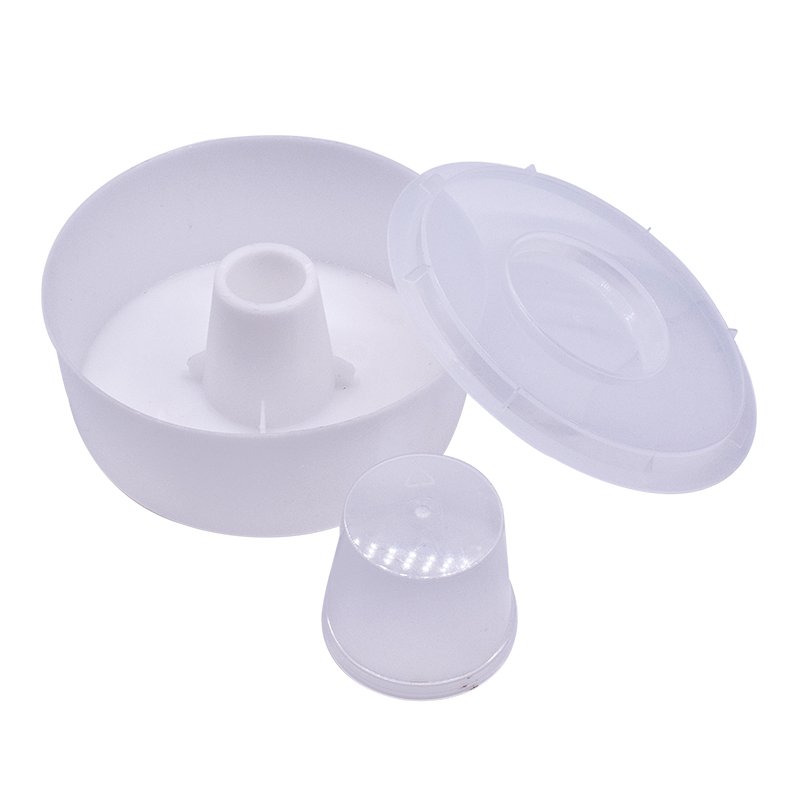
Two hardware points follow from this. Autumn feeding on a commercial scale is a throughput problem: the colony has to take a large volume of thick syrup in a short window, which is an argument for a top feeder that can be refilled without opening the brood box. And a feeder that leaks or admits rain works against the dry-nest objective that the whole management plan depends on. The square plastic feeder and the rapid top feeder with refilling from above are the two formats usually specified for that job; an entrance feeder suits light spring stimulation and top-up feeding rather than an autumn bulk feed.
Where Nosema sits next to Varroa
Nosema is rarely the sole cause of a winter loss. Varroa and the viruses it vectors are the larger driver in most operations, and a heavy mite load is what suppresses the immunity that keeps Nosema in check. If a count comes back high, check mite levels at the same time. Where both are over threshold, deal with the mites as well, because treating the gut alone will produce a colony that survives Nosema and dies of virus anyway.
Queens are the third item. Nosema suppresses laying and infected queens are superseded or die over winter. Requeening an infected colony without treating it puts a new queen into a gut problem, which is a waste of a queen.

Two hemispheres, two windows
Northern hemisphere (North America and Europe). Sample in autumn, roughly September to October, before colonies are confined or wrapped for winter, and again in early spring, roughly March to April, once the first cleansing flights have happened. Bees defecate in flight when the air is above about 10 °C, and long confinement below that temperature is what drives spore loads up inside the cluster. Autumn is the window that changes the feeding plan; spring is the window that tells you whether the plan worked.
Southern hemisphere (Australia, New Zealand, Chile, Argentina). Shift the calendar by six months. Sample in autumn, roughly March to May, before the winter cluster period, and again in early spring, roughly September to October, as build-up begins. The main honey flows run from about October to March in these markets, so an autumn count lands before the dearth that a Nosema load will exploit. Where an operation runs in both hemispheres, keep one sampling protocol and one recording format so the two sets of numbers are comparable.
On a large operation, do not sample everything. Sample a fixed subset of colonies per apiary at each window, record the result against the apiary and the date, and build your own seasonal baseline. A single count tells you whether to act now. Three years of counts tell you which apiaries are always high, which is a siting and management problem rather than a feeding problem.
Summary: turning a count into a plan
Sample 30 to 50 older bees per colony, macerate the abdomens of 30 in 15 ml of water, count five blocks on a haemocytometer at ×400, and calculate spores per bee with whichever published formula you started with — then never change it. One million spores per bee is the working threshold across North America, and it carries a published caveat: it was set for N. apis and has not been validated for N. ceranae.
Read the count against the calendar. In the northern hemisphere, autumn counts above the threshold change the feeding plan for the winter ahead, and spring counts tell you whether the plan held; in the southern hemisphere the same two windows fall in autumn from March to May and spring from September to October. Autumn means thick 2:1 syrup, dry hives, and medicated feed only where it is registered and only under label conditions.
Treat the equipment as part of the treatment. Comb replacement and acetic acid fumigation of stored comb are what stop the same apiary coming back high the following year, and fumagillin exposed to sunlight is fumagillin that does nothing. Check Varroa and queen status alongside the count, because Nosema is usually one of three problems rather than the only one. For the seasonal feeding hardware behind all of this, the bee feeders and medicine category covers the top-feeding and entrance-feeding formats used in both calendars. Managed pollination makes the broader case for keeping colonies healthy through winter: the FAO pollination pages set out how much crop production sits behind it.