

A feeder decision that works for thirty colonies usually fails at five hundred, and it fails for a dull reason. Hardware cost scales with colony count. Labour cost scales with fill events, and fill events are set by capacity. A half-litre entrance feeder and a ten-litre tray feeder differ by a factor of twenty in how often somebody has to put hands on a hive. Across one autumn feeding programme that factor is the entire wage bill.
This is written for commercial bee feeder selection at yard scale, and for the distributors who supply those yards. It covers the five architectures in production, what each one physically does with the syrup, how capacity converts into tank loads and fill events, where robbing risk actually sits, the difference between building winter stores and stimulating spring build-up, and what a 500-colony autumn programme costs in units and hours. Prices are deliberately absent from this page. Feeder pricing moves with resin, order quantity and Incoterm, so ask the supplier for a current quotation rather than working from a number printed here.
What changes when a commercial yard feeds 500 colonies
Three constraints appear at scale that do not exist at hobby scale.
Syrup becomes a logistics problem first. New South Wales Department of Primary Industries guidance on wintering bees puts winter feeding at a 2:1 sugar-to-water ration and notes that up to 10 kg of sugar may be fed to each hive, with 2.5 kg of sugar roughly equal to one frame of honey. Ten kilograms of sugar per colony is 5,000 kg of sugar for a 500-colony yard. At 2:1 by mass that is about 15 kg of syrup per colony, or roughly 11.1 litres using the 1.35 kg/L conversion practitioners commonly apply to 2:1 syrup. That is a computed figure, not a measured one; syrup density varies with temperature and mixing method, so weigh a known volume from your own mixer before you plan a tank fleet.
Feeding has a hard closing date. The same DPIRD guidance warns that syrup not consumed within three days should be discarded, because it ferments. Syrup that ferments in a feeder is worse than no syrup at all: it produces dysentery in confined winter bees and it attracts robbers from every colony within flight range. A programme built around large, infrequent fills risks spoilage; a programme built around small, frequent fills risks labour. The capacity choice is where those two risks are traded against each other.
Robbing scales non-linearly. Two hundred hives standing in one yard, all fed on the same afternoon, is a very different environment from twelve hives in a garden. Once robbing starts at that density it spreads down the rows faster than a crew can walk them, and the cost is measured in dead queens and destroyed weak colonies rather than in lost syrup.
The five architectures, and what each one physically does
Feeders are usually described by shape. What matters at yard scale is where the syrup sits relative to the cluster, how many bees can reach it at once, and whether the hive has to be opened to refill.
| Architecture | Typical capacity (L) | Refill without opening the hive | Syrup position | Robbing risk |
|---|---|---|---|---|
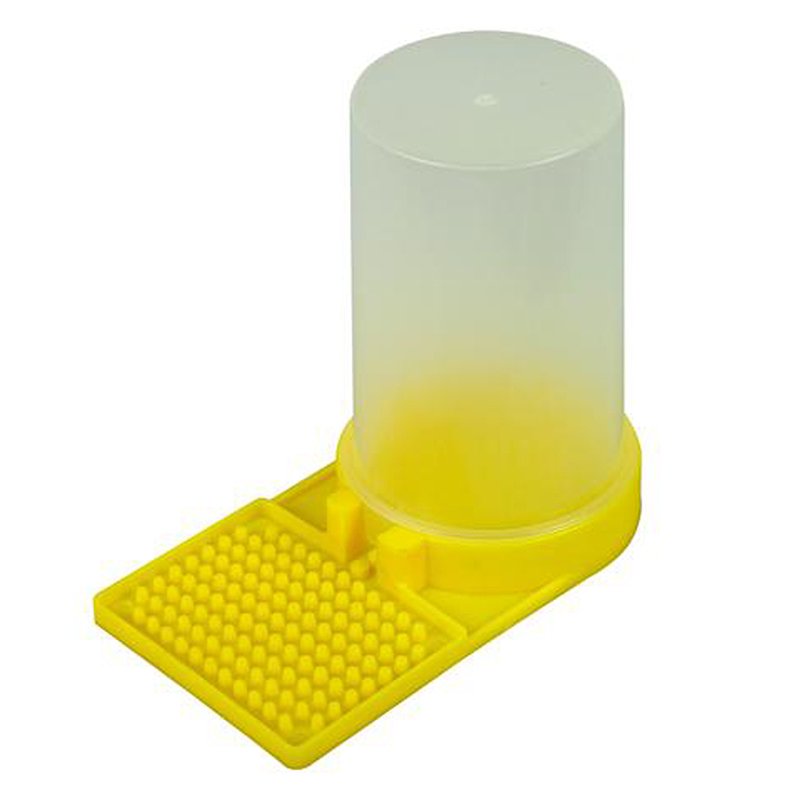
| Entrance (Boardman) feeder | 0.5 L per unit (typical catalogue figure) | Yes, from outside at the entrance | Outside the hive envelope, at the entrance | Highest of any internal option; the syrup scent is broadcast at the flight entrance |
| Frame (division board) feeder | 2 to 3.5 L depending on model | No; the brood box must be opened | Inside the box, immediately beside the cluster | Low; scent is contained inside the hive |
| Round rapid top feeder | About 2 L | Partly; sits over the inner cover hole under an empty box or the roof | Above the brood box, inside the hive footprint | Low, provided the roof seats properly with no gap |
| Pail or bucket feeder (inverted, perforated lid) | 1.1 L, 2.24 L and 4.5 L are the standard commercial sizes | No as supplied; needs an empty box around it, after which the lid can be lifted | Above the inner cover, inside an added box | Low while boxed in; high if syrup is spilled during the flip |
| Tray feeder (Miller or Ashforth type) | 10 to 12 L | No; the roof comes off, but the fill volume is large enough that visits are few | Full hive footprint on top of the brood box | Low; this is what commercial yards use for autumn volume |
The distinction that gets lost in most catalogues is between capacity and uptake rate. A tray feeder and a contact feeder can hold very different volumes yet deliver at similar rates, because uptake is governed by how many bees can stand at the syrup surface at the same moment. UK association guidance makes the point directly: access length is the deciding variable, with a side-access Ashforth feeder offering roughly seventeen inches of edge and a centre-access Miller feeder roughly thirty-four inches. A Miller feeder really is fast; a small round feeder sold as “rapid” is not, whatever the label says.
Entrance feeders deserve a specific warning for commercial buyers. They are cheap, they are visible without opening the hive, and they are the worst available choice for a dense yard. Feeder guidance aimed at commercial operators states plainly that entrance feeders carry the highest robbing risk and that the convenience rarely outweighs it. Their legitimate uses are narrow: water supply in hot weather, a quick top-up on a nuc, and a check that costs nothing to walk past.
Frame feeders solve a different problem. Because the syrup sits beside the cluster and uses hive warmth, they work in cool weather when syrup above the inner cover would be out of the cluster’s reach. The trade is that every refill is a full hive opening. The consequences of that are quantified below.

Capacity, fill events and how far one tank load goes
Take the 11.1 litres of autumn syrup per colony derived above, and the arithmetic tells you how many times each design has to be filled, and how many colonies one 200-litre tank load services in a single pass. Both numbers are derived, not measured. The capacity column is drawn from published catalogue and association figures; the fill counts are division.
| Feeder option | Capacity (L) | Fills per colony per autumn (11.1 L target) | Colonies serviced per 200 L tank load | Tank loads for 500 colonies per pass |
|---|---|---|---|---|
| Entrance feeder, 0.5 L | 0.5 | 23 | 400 | 2 |
| Round rapid top feeder, 2 L | 2.0 | 6 | 100 | 5 |
| Frame feeder, 3.5 L | 3.5 | 4 | 57 | 9 |
| Pail or bucket feeder, 4.5 L | 4.5 | 3 | 44 | 12 |
| Hive-top reservoir, 8 L (mid of the 2 to 3 gal range quoted by suppliers) | 8.0 | 2 | 25 | 20 |
| Miller or Ashforth tray feeder, 10 L | 10.0 | 2 | 20 | 25 |
Read the third column first. Twenty-three visits per colony is not a feeding programme, it is a permanent occupation of the yard. An entrance feeder used as a primary autumn feeder costs more in wages in a single season than a tray feeder costs to buy, several times over.
Read the fourth column second, because it drives vehicle and tank planning. A 200-litre tank on a pickup feeds twenty colonies per pass if you are running tray feeders, and four hundred if you are running entrance feeders. Neither extreme is usually the answer. Most operations land between the 2 L and 4.5 L options, where a single tank pass covers forty to a hundred colonies and the crew completes a yard in five to twelve passes.
The volume itself sets the mixing and storage requirement: 500 colonies at 11.1 litres is about 5,560 litres of syrup for the season, or roughly twenty-eight 200-litre tank loads. Stainless storage capacity has to be specified on that number, not on the honey crop, and it has to be food-contact graded and cleanable, because syrup residue is exactly the medium that grows yeast overnight.
Robbing risk, by design
Robbing is triggered by scent and opportunity, not by hunger. Four rules follow from that, and they are cheap to apply.
Keep the syrup inside the hive envelope. Internal feeders keep the scent out of the air around the stand. Open feeding in troughs, or any spilled syrup at the entrance, does the opposite. Feeder guidance for commercial operations is unambiguous that entrance feeders are the highest-risk design and that spillage during filling is a common trigger in its own right.
Close the entrance down. UK association guidance recommends reducing the entrance during feeding. The New South Wales guidance gives a winter figure of 50 to 75 mm, which lets a weak colony guard what is left. On a 500-colony yard this should be done yard-wide before the first fill, not colony by colony after the first robbery.
Feed late in the day. Syrup put on in the evening is taken overnight by residents rather than contested in the afternoon by neighbours. It also means the highest-risk hours, when every colony in the yard smells sugar at once, happen when the crew has already left.
Do not feed while saleable honey supers are on. Bees store syrup in the comb exactly as they store nectar. Feeding through a flow adulterates the crop and it cannot be sold as honey afterwards. This is a commercial loss, not a technicality.
Winter build-up versus spring stimulation: two different jobs
Feeding is not one activity. It is two, with opposite design requirements, and buying one feeder for both is the most common procurement error in this category.
Autumn build-up. The objective is volume delivered and cured before the cluster stops flying. Thick syrup, 2:1 by mass, reduces the water the colony has to evaporate. Large capacity wins, because the number of visits matters more than the disturbance from any single visit, and because disturb-and-reseal cycles late in the season cost cluster heat. Tray feeders and hive-top reservoirs exist for this window.
Spring stimulation. The objective is a steady trickle that mimics a nectar flow and drives brood rearing. Thin syrup, 1:1, is the standard recommendation for this, and the delivery rate should be slow and continuous rather than a flood. Contact feeders and small round feeders suit this window; a 10 L tray dumped onto a colony in early spring is stimulation followed by a dearth, which is worse than a steady small supply.
Northern hemisphere. In North America and Europe the autumn window is broadly August into September, finishing early enough that syrup is ripened and capped before night temperatures stop processing; spring stimulation runs roughly March into April. The hardware decision for the autumn window has to be settled in the preceding winter or spring, because that is when the container ships.
Southern hemisphere. In Australia, New Zealand and southern South America the equivalent autumn window falls roughly March into May, with spring stimulation from about August into October. Distributors supplying Australasia should hold stock landed by February for the autumn programme, and should hold spring stimulation stock by July. Getting this backwards is a common and entirely avoidable miss: a yard that receives tray feeders in April has missed its own winter.
What the handling-time data actually shows
There is measured work on this, and it is worth quoting rather than estimating. A 2021 field study published by Science Publishing Group compared top, bucket and frame feeders across apiaries, recording time to place and remove the feeder, and dead bees, over sixty colony-feedings. The mean time to feed a colony across all feeder types was 83.17 seconds plus or minus 6.17, with a range of 31 to 180 seconds. Broken out by type: top feeder 40.45 s, bucket feeder 71.25 s, frame feeder 137.80 s. Dead bees under the hive stand ran 2.50, 5.45 and 11.00 respectively, and dead bees in or on the feeder at removal ran 0.00, 0.20 and 1.60.
Two things follow. First, the feeder that requires the hive to be opened costs roughly three and a half times the handling time of the one filled from above, and that ratio is the same at ten colonies and at five hundred. Second, the same ordering appears in bee mortality, so the slower option is also the more damaging one. The study’s own explanation is mechanical: the top feeder sat on the inner cover, needed no frame removed and no extra super added, and let the operator refill without disturbing the colony.
Those figures are hive-side handling only. They exclude walking between hives, mixing, tank refills, and suiting up. On a real route, add your own measured travel time per hive; do not borrow a number from another operation, because stand layout and row spacing dominate it.
Cleaning, disinfection and what survives the off-season
Feeders are the equipment most likely to move a pathogen between colonies, because they are removed from one hive and placed on the next by hand. A disinfection step is not optional on a commercial yard.
Clean first. Every source agrees on this and the reason is physical: disinfectant only kills what it touches. Wax, propolis and syrup crust shield organisms underneath. Scrape and wash before any chemical step.
Routine hygiene. Washing soda at 1 kg to 5 litres of water, soaked, scrubbed and rinsed, is the standard field recipe for general equipment and is effective against insects, mites and fungi. A hot soda solution is alkaline enough to irritate skin, so gloves and eye protection belong on the job sheet.
Spore-level disinfection. New Zealand’s American foulbrood management manual reports Ruakura research showing that 0.5 percent sodium hypochlorite in water kills all AFB spores in 20 minutes, and notes that household bleach carries roughly 3 percent sodium hypochlorite, so dilution matters. The same manual is explicit about the limits: the solution only kills what it contacts, some plastics, metals and especially leather degrade in it, the solution breaks down in sunlight and should not be stored, and the 20-minute contact time is the whole point. Soak plastic and metal feeders, not gloves.
What cannot be disinfected. AFB is a notifiable disease and equipment from a confirmed colony is destroyed by burning, not treated. Sodium hypochlorite is a preventive measure against spread, not a cure. Steam and scorching are effective on wooden boxes but neither is a substitute for a burn order.
Off-season storage. Tray feeders with glued or nailed joints should be leak-tested before storage and again before use, because a slow leak in autumn is a robbing trigger and a drowning site at the same time. Plastic feeders should be stored out of UV. Wooden feeders stored damp will not seat flat the following year, and a feeder that does not seat flat lets robbers in.
Filling drawn comb instead of feeding from a vessel
There is a fifth method that bypasses the feeder question entirely: filling drawn, empty combs with syrup and placing them directly beside the cluster. It is used in parts of Asia and Eastern Europe for winter provisioning and for rapid spring build-up, and it has one genuine advantage and two serious constraints.
The advantage is uptake. Bees take syrup from comb in the brood nest faster and with less蒸发 work than from any vessel, and the syrup is stored where the cluster can reach it in cold weather.
The constraints are spoilage and robbing. Syrup in open cells starts fermenting if it is not taken within days, and the DPIRD three-day discard rule for unconsumed syrup applies here with more force than anywhere else. Filling combs is also an open-air operation during a dearth, which is exactly the condition that starts robbing across a whole yard. In practice this method suits strong colonies, short windows, and crews that can fill and place in the same pass. Throughput depends on the filling equipment used; ask the supplier for a measured figure rather than assuming one.
For most export buyers we supply frame feeders and round top feeders alongside the hive bodies, and reserve comb filling for customers who already have the drawn comb and the crew discipline to run it. A square plastic feeder covers the year-round middle ground where a yard wants one unit type rather than a seasonal pair.
Cost and labour for a 500-colony yard
The table below is the summary buyers ask for. Unit prices are not quoted: ask the supplier for a current quotation, because feeder pricing depends on resin grade, order quantity, colour, tooling and Incoterm, and any number printed here would be stale before the container shipped. Everything else in the table is either a published catalogue figure, a measured figure from the study cited above, or arithmetic on those two, labelled as such.
| Option for 500 colonies | Units required (500 + 10 percent spare) | Unit price (ex-works) | Measured handling per fill (s) | Fills per colony per autumn | Yard handling per autumn (h) | Suited to |
|---|---|---|---|---|---|---|
| Entrance feeder, 0.5 L | 550 | Ask supplier for current quotation | Not measured in the cited study; use your own stopwatch | 23 | Derives to 265.7 h if the study mean of 83.17 s applies | Water, nucs, spot checks only |
| Round rapid top feeder, 2 L | 550 | Ask supplier for current quotation | 40.45 (top feeder, measured) | 6 | 33.8 h | Spring stimulation, top-ups, general purpose |
| Frame feeder, 3.5 L | 550 | Ask supplier for current quotation | 137.80 (measured) | 4 | 76.6 h | Cool-weather feeding, nucs, small blocks |
| Pail or bucket feeder, 4.5 L | 550 | Ask supplier for current quotation | 71.25 (measured) | 3 | 29.7 h | Fast autumn feeding where tray feeders are impractical |
| Miller or Ashforth tray feeder, 10 L | 550 | Ask supplier for current quotation | Not measured; assume comparable to top feeder and verify | 2 | 23.1 h at the 83.17 s study mean | Autumn volume feeding, the commercial standard |
The hours column is hive-side handling for 500 colonies across one autumn programme, computed as fills per colony multiplied by handling time per fill, multiplied by 500, divided by 3600. It excludes travel, mixing and tank refills. The spread is the point: the same 5,560 litres delivered through tray feeders costs roughly a third of the crew hours that frame feeders cost, and roughly an eighth of what entrance feeders would cost.
Two further lines belong in any budget built from this table. The spare allowance is not padding; feeders crack in cold weather, lids go missing, and a yard that is ten units short in the last week of the feeding window has no cheap fix. And every option above assumes one feeder per colony; yards that rotate tray feeders between blocks can reduce unit count, at the cost of a second visit to remove them.
When you write the purchase order, specify capacity in litres at the fill line, material as food-grade and identified by grade, and whether the unit is intended for internal or entrance use. Those three lines prevent most of the mismatch complaints we see from distributors.
Our own feeder range is grouped in one place for that reason: the feeders and medicine category carries the entrance, round rapid and general-purpose units alongside the treatments that run on the same autumn visit. The round rapid top feeder is the one most yards standardise on where refilling has to happen without opening the brood box, and the plastic entrance feeder is the one we sell for water and emergency top-ups rather than for volume programmes.
Background worth reading before the supplier conversation: colony-loss and management context from the Honey Bee Health Coalition, operating practice and colony numbers from the US national beekeeping survey, and production and pollination context from FAO’s pollination programme.