
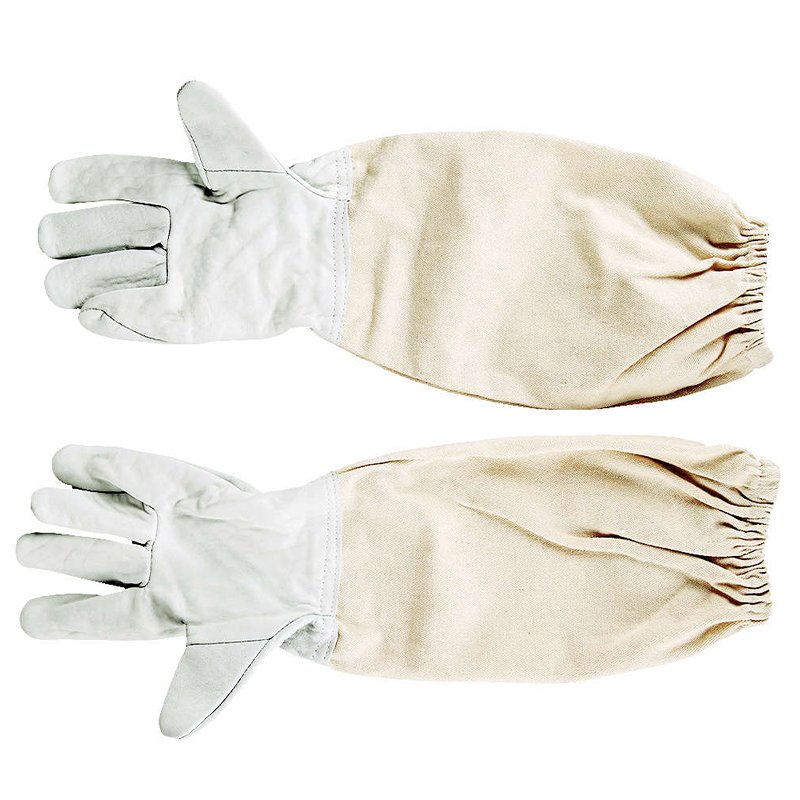
A container order of hives is a dimensional purchase. A container order of gloves is not, or it becomes one the moment a crew of thirty hands has to be fitted, issued, replaced and budgeted for. Gloves are the line item that gets ordered last, specified loosest and complained about longest, because nothing about them looks technical until the second season in the field.
This is written for the buyer placing the order: the distributor building a catalogue, the commercial operation kitting out crews, the importer who has to answer when a customer says the medium is not the medium they sold last year. It covers what the material has to stop, how thickness and sleeve length interact with heat, which test values can go into a specification and which cannot, how to build a size ratio from your own crew rather than from a catalogue, and the cost table to put in front of a supplier before asking for a price. Managed pollination and honey production both scale with colony numbers, and FAO’s pollination pages set out why those colony numbers keep climbing; every additional colony carries another pair of hands at inspection time.
What actually has to be stopped
The barrier problem in beekeeping gloves is different from the barrier problem in almost every other hand-protection category, and the difference explains why most comparative advice on the internet is unhelpful. A sting is not a staple gun, not a nail, and not a hypodermic needle.
Measured work on the honey bee sting apparatus gives a sense of scale. In a 2017 study of worker stingers of Apis cerana published in the Journal of the Mechanical Behavior of Biomedical Materials, the whole stinger measured 1.75 to 1.86 mm in length, the shaft of the sting was about 1.1 mm, and the tip radius was in the range of 1 to 1.5 micrometres. The same work reported ten barbs distributed symmetrically on each lancet, each barb 11.3 to 17.6 micrometres long. A related measurement from the same group put the force needed to penetrate artificial skin at roughly 1.34 millinewtons.
Those figures come from one species, measured on one set of instruments, and the commonly quoted range for honey bees generally is wider. Practitioner-facing sources across beekeeping supply and extension writing place the stinger at about 1.5 to 2.0 mm. Treat the precise values as species- and method-dependent, and treat the order of magnitude as settled: this is a sub-two-millimetre, micron-tipped structure, and it is closer to a fine entomological pin than to anything a mechanical-risk standard tests with.
That last point matters more than the numbers. Under EN 388:2016+A1:2018, puncture resistance is measured with a steel stylus 1 mm in diameter driven at constant speed into a sample cut from the palm. ANSI/ISEA 105 uses a stylus with the same specification. A 1 mm diameter probe cannot rank materials against a structure whose tip radius is measured in single-digit microns. So a glove rated EN 388 puncture level 1 is not thereby a poor beekeeping glove, and no tested EN 388 puncture level should be sold to your customer as a claim about sting protection. That misrepresentation is the single most common thing we see wrong on glove product pages.
The five material families, and what each one is good at
Buyers usually ask which material is “best”. The honest answer from a factory side is that each one wins on one axis and loses on another, and the useful question is what the crew spends most of its time doing.
| Material | Typical thickness (mm) | Dexterity | What it is chosen for | What it gives up |
|---|---|---|---|---|
| Goatskin grain | 0.6–1.0 mm across published supplier ranges | High | General inspection work, queen handling, frame work | Abrasion life at the fingertips; hides vary by tannery |
| Sheepskin / lambskin | 0.6–0.9 mm across published supplier ranges | Very high | Fine work where feel is the priority, cooler conditions with a liner | Tear strength; thins locally at high-wear points |
| Cowhide, full grain | 0.8–1.4 mm across published supplier ranges | Low to moderate | Defensive colonies, removals, heavy yard work | Break-in period; heat load in midsummer |
| Cowhide split (suede) and coated textiles | Varies widely with backing and coating build — ask the supplier for a measured value | Moderate | Price-led retail lines, mixed promo assortments | Consistency between batches; coating can crack on flex |
| Nitrile-coated knit, or unsupported nitrile | Coating typically 0.1–0.2 mm; disposable exam grades quoted in mil | Highest | Queen marking, grafting, sampling, handling treatments where the label calls for chemical-resistant gloves | Mechanical protection and forearm coverage |
The thickness ranges above are compiled from published supplier technical content, not from a standard. Different glove makers publish different windows for the same hide because they buy different selections, split to different thicknesses and finish differently: one glove-leather manufacturer publishes 0.8–1.0 mm for goatskin with tensile strength up to about 14 N/mm², another quote for general glove leather puts goatskin at 0.7–0.9 mm, and beekeeping-specific retail writing tends to quote goatskin at 0.6–0.9 mm against cowhide at 1.0–1.4 mm. The ranges overlap and none of them is a specification anyone can enforce. If thickness is the thing you care about, ask for a measured value with the measurement method stated, not a range.
What each material does in the field follows from that. Goatskin has been the default working choice for decades because it combines a fine grain with enough substance to hold up at the knuckles. Sheepskin is softer and gives better feel, and at the bottom of its thickness window it stops being a working glove and becomes a liner. Cowhide buys protection and costs fine motor control. Coated textiles are what make aggressive retail price points possible, and their failure mode is coating delamination rather than a hole you can see coming. Nitrile belongs in the toolbox for tasks where the bee is not the hazard: operations such as queen marking and grafting, and any operation involving mite treatments where the product label specifies chemical-resistant gloves. For those tasks the reference point is the product label, and EPA’s pollinator protection pages are the starting point for how treatments are regulated in the United States.
Within our own range, the split is practical rather than theoretical. Buyers building a general-purpose line tend to stock a goatskin glove with a canvas sleeve as the volume item and a lighter sheepskin glove as the step-up option. The beekeeper protective gear category is organised along those lines for exactly that reason.
Specify thickness as a measured value, not a range
A cover letter that says “0.8–1.0 mm goatskin” is a conversation starter, not a specification. Two questions turn it into something enforceable.
Where is it measured? Thickness varies across a hide. Ask for the value measured on the palm of a finished glove, at a stated point, on a stated number of pieces per batch. A palm measurement and a shoulder-of-hide measurement are different numbers for the same glove.
What happens at the thinnest permitted point? Because stings tend to land where leather is pulled tight over the knuckles and where it thins at the fingertips through wear, the minimum matters more than the average. A tolerance band with both limits stated, measured at palm and fingertip, is a reasonable thing to ask for and it costs the tannery nothing to respect.
The practical failure associated with this is specific and worth describing to your customers: somewhere below roughly 0.5 mm of glove leather, stings begin getting through in normal use. That threshold is a practitioner observation repeated across beekeeping retail writing rather than a tested limit, and thin imported gloves are regularly cited as the culprit. Ask your supplier for the actual lot measurement rather than assuming any tolerance from a photograph.
Heat is the reason people take gloves off
Most sting injuries on crews do not happen because the glove failed. They happen because the glove was in a pocket. Sweat-soaked hands, slipping grips, and a worker who decides one inspection without gloves is worth the risk translate into exactly the injury pattern the glove was bought to prevent.
The regulatory reference here is EN ISO 21420:2020, the general requirements standard that replaced EN 420:2003. It asks protective gloves to transmit water vapour where possible and applies thresholds for the material classes; the figure published in commentary on the standard for leather is above 5 mg/(cm²·h), alongside a water vapour resistance limit for knitted textile gloves. Beyond the standard, two design levers actually change how a crew behaves in the field.
Ventilated backs. A mesh or perforated panel on the back of the hand and up the forearm moves a noticeable amount of air and, more importantly, changes how long a worker will keep the gloves on. Vented construction is the single most requested upgrade from customers in subtropical and hot-summer markets.
Colour. White and pale leather gloves run cooler than dark ones under direct sun. It is a small effect and it costs nothing, which is why it belongs in a specification.
Seasonally a procurement calendar has to run two ways. In the northern hemisphere, crews are finishing varroa treatment, wrapping hives and writing next year’s equipment budget between roughly October and December; the glove order that follows has to land before the first warm inspection window in March or April. In the southern hemisphere, the same period is spring build-up and swarming control, with purchase decisions made around August to October so that stock is on the shelf before the September to November peak. A single shipping plan serving both markets puts two order cycles in one calendar year, which is the strongest argument for holding the cargo specification stable across seasons.
Two products illustrate the design difference: a ventilated goatskin glove with an extra-long sleeve for warm-climate crews, and a conventional build elsewhere in the range where insulation matters more than airflow.
Reference values that belong in a written specification
The values below are published standard thresholds, not measurements of our products. They are the numbers a buyer can hold a factory to, and each one carries units because a number without units cannot be audited.
| Property | Standard | Unit | Threshold by performance level |
|---|---|---|---|
| Abrasion resistance | EN 388:2016+A1:2018 | Cycles to holing | Level 1 >100 · Level 2 >500 · Level 3 >2,000 · Level 4 >8,000 |
| Tear resistance | EN 388:2016+A1:2018 | Force in newtons | Level 1 >10 N · Level 2 >25 N · Level 3 >50 N · Level 4 >75 N |
| Puncture resistance | EN 388:2016+A1:2018 | Force in newtons | Level 1 >20 N · Level 2 >60 N · Level 3 >100 N · Level 4 >150 N |
| Puncture resistance | ANSI/ISEA 105-2024 | Force in newtons | Level 1 ≥10 N · Level 2 ≥20 N · Level 3 ≥60 N · Level 4 ≥100 N · Level 5 ≥150 N |
| Dexterity, smallest pin handled | EN ISO 21420:2020 | Pin diameter in mm | Level 1 = 11.0 mm · Level 2 = 9.5 mm · Level 3 = 8.0 mm · Level 4 = 6.5 mm · Level 5 = 5.0 mm |
Three things follow. First, EN 388 and ANSI/ISEA 105 share the same stylus geometry but not the same scale, so a level 4 under one is not a level 4 under the other — the European scale tops out where the North American scale still has a step to go. Second, EN 388 was revised in 2016 precisely because certain materials blunt the blade used in the traditional cut test, so results between laboratories under the older edition disagreed; anything quoted against EN 388:2003 is not comparable to a current certificate. Third, and already noted, none of these puncture levels models a bee sting, because the probe is built around hazards such as splinters and nails.
In Europe, protective gloves are governed by Regulation (EU) 2016/425 on personal protective equipment. This product category falls into Category II, intermediate risks, which requires EU type-examination by a notified body followed by conformity to type, alongside an EU declaration of conformity and CE marking. Tell a supplier you want the declaration of conformity naming the standard editions and the performance levels, and you will find out very quickly whether the file exists.
Innocuousness clauses that get missed
The 2020 revision of the general requirements standard widened the chemical requirements considerably, and these are the clauses that stop containers rather than hurting users.
For leather gloves, hexavalent chromium must be below 3 ppm. For gloves containing polyurethane, dimethylformamide must not exceed 1,000 mg/kg. Polycyclic aromatic hydrocarbons must not exceed 1 mg/kg in rubber or plastic materials intended to contact the skin; the threshold put forward in industry commentary on the standard is sometimes given as 1 ppm, so confirm the unit your own test house works to. Where metal components such as studs or clasps sit against skin for long periods, nickel release has to stay below 0.5 micrograms per square centimetre per week. The 2020 edition also requires manufacturing date, and obsolescence date where applicable, either on the product or on the first packaging enclosure.
Each of these is cheap to comply with at the factory and expensive to discover later. Ask for the test reports by batch rather than by model.
Sleeve length, cuff closure and where stings land
Most “the gloves failed” complaints are not about the leather. They are about the gap between glove cuff and suit cuff, and about the elastic at the top of the sleeve losing its tension.
Three lengths cover the market. A wrist-length cuff works only where a suit sleeve has a genuinely tight elastic seal, which many do not; stings on the inner wrist are the classic injury. A gauntlet running roughly 150 to 230 mm up the forearm is the default and the one we ship most often, because the overlap against the jacket sleeve is what actually excludes bees. Elbow-length gloves reaching about 300 to 400 mm are restrictive and are bought for removals, cut-outs and defensive stock, or for yard work near aggressive colonies where the work is short.
Closure types are a cost and a workflow decision rather than a safety one. Elastic is simple, fast and mid-priced. A drawstring is adjustable and slow to tighten one-handed. Hook-and-loop straps are common on heavier cowhide builds and need a fabric panel that will not fray. Sleeve fabric matters too: cotton canvas is traditional and breathes, polyester blends dry faster and keep colour better through washing, and either can be specified.
The white goatskin glove with canvas sleeves is the example of the standard configuration, and it is the configuration most distributors should open with.
Sizing systems, and hands that do not match them
EN ISO 21420:2020 publishes a reference hand sizing table, and it is worth knowing even for markets that do not require it, because most commercially published charts are variations on it. Hand circumference by size runs 152 mm at size 6, 178 mm at size 7, 203 mm at size 8, 229 mm at size 9, 254 mm at size 10 and 279 mm at size 11 — intervals of about one inch. Matching hand lengths in the same table are 160, 171, 182, 192, 204 and 215 mm respectively. The 2020 revision removed the minimum glove length requirement that the 2003 edition carried, so length now belongs to the design rather than the standard.
Two things trip up every first order. The published beekeeping charts are not always this table, and the numbers may be quoted either as hand circumference or as flat measurement across the palm — the two differ by roughly a factor of two and suppliers do occasionally mix them. Before agreeing a size specification, ask which measurement the factory’s chart uses and request a measured sample glove with the palm width stated in millimetres.
Shape is the rest of the problem. A worker with a long narrow hand and a worker with a short broad hand can share a circumference but need very different gloves: one loses fingertip room, the other bunches at the palm. Three shapes cover nearly everyone in practice. A long, slim hand usually wants one size down from the circumference reading and a glove with longer fingers. A square, broad hand usually wants one size up and more palm width. A hand with a thick palm but short fingers, common among crews doing manual yard work, wants the size set by palm width rather than by circumference, and will otherwise split the leather at the base of the thumb.
The fit test takes twenty seconds and should be written into the induction routine: with the glove on, the worker should be able to pick up a single frame lug and close a hive tool without the fingertips bunching, and should not be able to pinch more than a centimetre of loose leather at the palm.

Gloves are rarely the only protective item in the container. Suits, jackets and veils are usually travelling on the same booking, and the measurement sheet below can be extended to cover them.
Building a size ratio from your own crew
Distributors frequently ask for a “standard ratio” to order by. We do not publish one, and the reason is straightforward: there is no published hand-size distribution for beekeeping crews that we can honestly cite, and any ratio we invented would be a guess your stock would be built on. The alternative takes an afternoon and produces a number you can defend.
Step one: measure every hand, not a sample. Circumference at the knuckles, hand length from wrist crease to fingertip, and palm width. Record in millimetres. Do this at induction rather than on delivery day, because it is twenty seconds per person and it also sizes the rest of the personal protective equipment.
Step two: convert to the standard sizes using the factory’s chart, not this article’s. Once you have the chart, everyone falls into a size. Adjacent sizes at the boundary are recorded with a note — those are the people whose second pair should be the neighbouring size.
Step three: count, then normalise. Divide the count in each size by the total wearing population. The illustrative example below is arithmetic, not data: suppose 40 workers measured this way fall out as 4 workers at size 7, 11 at size 8, 14 at size 9, 8 at size 10 and 3 at size 11. Normalised, that is 10 percent, 27.5 percent, 35 percent, 20 percent and 7.5 percent respectively.
Step four: multiply by wearing pairs, not by workers. A crew of 40 does not buy 40 pairs. Each worker consumes several pairs over a season through loss, propolis staining in visible positions, and the natural rate at which issued kit goes missing. Decide your own issue rule — two pairs per worker per season is a common starting point for professional crews — and apply the percentage to the total pairs figure rather than to the headcount. Continuing the illustration, 40 workers at two pairs per head gives 80 pairs, which allocates to 8 pairs at size 7, 22 at size 8, 28 at size 9, 16 at size 10 and 6 at size 11.
Step five: round to the packing unit. Gloves are typically packed in dozens. Round each size up to the nearest dozen and accept the small surplus at the tail sizes, because a leftover pair of size 11 is cheaper than a crew member working in a wrong-fitting glove.
Step six: repeat annually and watch the drift. Crew composition changes, and so does ratio. A twenty-person turnover against a forty-person crew can move the middle two sizes by several points, which over three seasons is the difference between a balanced inventory and a box of size sevens nobody can wear.
One further note for importers: sizes above 11 and below 7 exist in most factories’ tooling but are rarely stocked. If your market skews outside the centre of the range, the cost of carrying those sizes is real, and it should be priced into the margin rather than discovered when a customer asks for size 13.
Wear rate, failure modes and setting an interval
There is no published service-life figure for beekeeping gloves, and any factory quoting one in months is quoting something it has not measured. What can be specified is the failure mode and a company-owned interval derived from your own records.
Four failures account for nearly all retirements. The leather dries and cracks after repeated wet-and-dry cycles with propolis acting as a solvent carrier, which is why machine washing is the fastest way to destroy a glove — it strips the natural oils and the leather dries hard. The seam between leather hand and textile sleeve opens, usually at the thumb. The elastic at the top of the cuff loses tension, after which bees walk in and the glove stops being worn. And the fingertip leather thins through abrasion against frame lugs and hive bodies until stings begin to land.
One beekeeping retailer publishes a figure of roughly 80 to 150 inspections before goatskin gloves show a mark. That is a single company’s field impression, not a test result, and it should be treated as such. If your operation wants a number, run one: issue forty marked pairs, record days worn and the reason for retirement, and after a season you will have a figure that applies to your own crews, your own climate and your own gloves. That number then becomes the replacement column in the cost table below.
Storage matters for another reason. Keeping leather dry, out of direct sun and away from heat preserves both suppleness and the chemical compliance file, and it is worth printing on the inner bag.

What is true for gloves is truer for the garments that travel beside them. A full suit or a jacket-and-veil combination sits at several times the unit cost of a pair of gloves, so the same method — measure the crew, build the ratio from the measurements, order to the ratio — pays back faster there.
Total cost per pair: build this table before asking for a price
Unit price is the number everyone negotiates and the number that decides least. For categories like this one, where replacement is continuous and every failure generates a small claim, the useful comparison is cost per wearing month across two or three constructions.
| Cost element | How to calculate it | Unit | What to obtain from the supplier |
|---|---|---|---|
| Landed unit price | Ex-works or FOB price plus freight allocation, insurance, duty and destination charges per carton, then divided by pairs delivered | Currency per pair | Ask for the current quotation on the exact specification; prices move with hide grade, size mix, sleeve length and order quantity, and no published figure holds across seasons |
| Service life | Days from issue to retirement, averaged over your own sample | Days per pair | Ask for a measured test report rather than a claimed range; switch to your own trial figures once you have them |
| Cost per wearing day | Landed unit price divided by service life | Currency per day | Not supplier-supplied; this is the number you compare between constructions |
| Pairs per worker per season | Issue rule multiplied by weeks worked, adjusted for recorded losses | Pairs per worker | Not supplier-supplied; set from your own stores records |
| Annual gloves spend per worker | Cost per wearing day multiplied by days worked, or landed price multiplied by pairs per worker | Currency per worker per season | The figure that should decide whether you are buying goatskin or cowhide |
| Compliance file cost | Declaration of conformity, notified body number, batch test reports for chromium VI and any coating chemistry | Documents per product line | These are supplied at no charge by a competent factory; a charge for them is itself informative |
Two ways to use it. Comparing a cheap construction against a dearer one on cost per wearing day usually reverses the price ranking, because a glove costing twice as much that lasts three times as long is cheaper and generates fewer conversations with your customers. And carrying fewer sizes but better ones typically beats carrying the full range thinly, provided the ratio comes from the crew measurement described above rather than from a catalogue.
For sheepskin options aimed at customers who prioritise feel, and for the goatskin and canvas lines that carry most of the volume, send us the size measurement sheet and the sleeve length you need and we will quote against the specification with the documents attached.
Two reference points that inform how this equipment is specified in the United States: colony loss and management survey data collected through the national beekeeping survey, and the honey bee research programme at the USDA Agricultural Research Service. Neither publishes glove standards, but both shape the working conditions the gloves are bought for.