
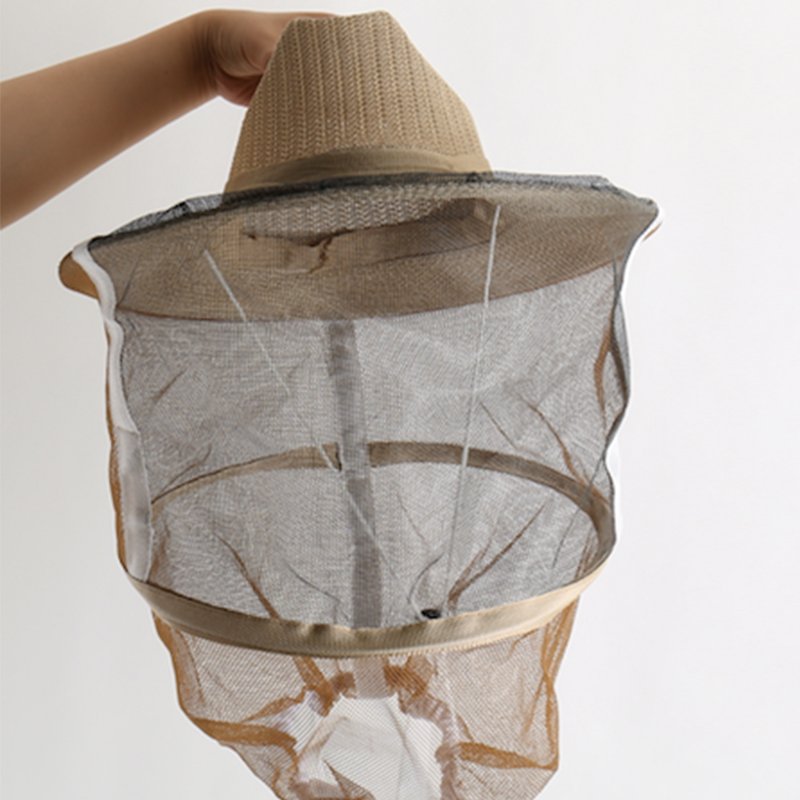
A veil does two jobs and they pull against each other. It has to hold mesh far enough from the skin that a sting cannot reach through, and it has to let the operator see a queen, an egg or a varroa mite on a frame in bright sun. Every veil design on the market is a different answer to that trade-off, and the differences show up in inspection speed, eye strain and how many bees end up inside the hood.
This is written for operations buying veils by the carton and for distributors whose customers judge a suit by its hood. Visibility is the specification most often left off a purchase order, and it is the one that drives returns.
The physics that governs every veil
A honey bee’s sting is a few millimetres long. A veil therefore does not work by being thick; it works by being away from the face. The protection is the air gap, and the structure — hat brim, stiffened ribs, wire frame — exists only to hold that gap open when the operator bends over a box, turns their head quickly, or gets hit by wind.
This produces a single, testable rule: a veil does not protect where it touches you. Mesh pressed flat against a cheek, a forehead or the back of the neck is mesh a sting can reach through. Both main designs fail in exactly the same way, and it is contact, not mesh quality, that causes it (Bee Suit Wear, fencing vs round veil comparison). So when comparing designs, the first question is not “which has better visibility” but “which holds its shape in the positions my crew actually works in”.
The second physics point is colour. Veil mesh is black for a reason. Light-coloured mesh reflects ambient light back into the eye and creates glare, black mesh absorbs it and effectively disappears from the field of view, which is why black mesh makes small detail — eggs, larvae, a queen — readable in direct sun (Bee Explained veil buying guide; HonestBee mesh analysis). A white or silver mesh veil is a real product and it is the wrong one for inspection work. Some designs keep white canvas at the crown and neck and black mesh only in front of the eyes, which is a reasonable compromise.

Three geometries compared
Commercial supply settles into three shapes, plus a budget fourth.
The round veil hangs from a wide, stiff hat brim. The mesh drops from the brim to the shoulders, where it is drawn in or zipped to the suit. The hat is the structure; the head moves independently inside it. Because the brim holds the mesh out at a constant radius, the round design gives a wide, even field in every direction and the largest standoff at its widest point.
The fencing veil is a self-supporting hood. Stiffened ribs hold the mesh out, the hood zips directly to the suit collar, and it turns with the head. Because it moves with you, the mesh-to-face distance stays constant no matter how fast you turn, which is why most commercial operators use it. It folds flat, needs no separate helmet, and leaves no brim across the eyeline when you look up into a swarm.
The square or folding veil uses a rigid collapsible square frame, sometimes over a helmet. The flat front panel gives undistorted viewing through a rigid plane rather than through gathered netting, and the whole thing packs flat — which matters when you are transporting dozens at a time. The corners are the weakness: they create blind spots at the edges of peripheral vision, and wire mesh kinks if it is crushed in a bag.
The pull-over soft veil has no structure at all. It is cheap and stuffs in a pocket, and it is a spare for a visitor, not a work item. Without a stiff hat underneath it drapes onto the face and stops protecting.
| Factor | Round veil | Fencing veil | Square / folding veil | Pull-over soft veil |
|---|---|---|---|---|
| What holds the mesh out | Hat brim | Stiffened ribs in the hood | Rigid collapsible frame | Nothing — needs a hat underneath |
| Movement relative to head | Stays put; head turns inside it | Turns with the head | Turns with the head | Moves with fabric |
| Standoff consistency | Large at widest, varies as head turns | Moderate, consistent | Moderate, consistent | Poor |
| Upward view | Restricted by the brim | No brim in the eyeline | No brim in the eyeline | Poor |
| Peripheral view | Wide, even in all directions | Good front and sides, narrower at rear | Flat front panel, blind spots at corners | Poor |
| Airflow | Best — open air path between brim and shoulders | Good | Good | Poor |
| Sun shading | Brim shades face and neck | Little | Little | Little |
| Separate helmet needed | Yes | No | Usually | Yes |
| Packed bulk | Bulky; hat must keep shape | Folds flat | Folds flat, wire can kink | Pocket-sized |
| Quick face access | Remove the whole veil | Zip-open front panel | Lift or unzip | Lift |
| Glasses | Extra clearance helps | Mesh can touch lenses if hood is small | Flat front suits lenses | Poor |
| Published retail price band | from about USD 20 | about USD 50; suits from about USD 90 | about USD 30–60 | under USD 15–25 |
Price band sources: Bee Suit Wear published product pricing (2024), Bee Explained veil buying guide (2025) and FarmstandApp veil guides (2024–2025). These are retail figures for individual items and are given only to show relative positioning; wholesale pricing for a container order is a separate quotation.
Note that no design wins on protection when sealed correctly. Published comparisons state the two main designs offer equivalent sting protection when properly sealed and made from sound mesh, and that the difference is visibility, heat and convenience (Honey Harvesting, round vs fencing comparison). Choose on the work, not on fear.

Mesh specification: the numbers worth asking for
Veil mesh is usually sold on description rather than on test data. For a bulk order, ask for three things.
Mesh thickness. Published beekeeping garment specifications put veil mesh thickness above 2.5 mm measured to EN ISO 5084 (Apiprotec fabric and mesh specification). A thicker mesh holds its shape away from the face better and resists being blown in on a windy day.
Burst strength. The same published specification gives mesh burst strength of at least 800 N to EN ISO 13938-1. That is a seam-and-mesh integrity figure, not a sting figure, and it is a reasonable proxy for how the hood survives a season of being stuffed into a truck.
Standoff distance. This is the number nobody publishes and the one that actually matters. There is no industry standard figure for mesh-to-face clearance; it varies by model and by head size. Ask the supplier for a measured standoff, or measure it yourself: put the veil on a crew member, have them look down at a hive-height surface, and measure from the brow to the mesh with a rule. Anything that closes to zero when the wearer bends forward is a failed design regardless of what the catalogue says.
Then check the seal, because the neck is where bees get in. A fencing hood zipped to the suit collar removes the gap entirely; a separate hat veil tied with strings leaves a gap that opens when the wearer bends. Where two zippers meet, look for an overlapping flap over the junction — published guidance flags a single zip meeting at the front as a common failure point, because a single missed tooth is an entrance (FarmstandApp veil features guide).
Specifying veils on a bulk order
Write the hood into the purchase order as a set of checks rather than a style name. “Fencing veil” alone will get you anything from a stiff, well-ribbed hood to a soft one that collapses onto the nose.
| Check | How to verify | What a pass looks like |
|---|---|---|
| Mesh colour | Visual, against a light box | Matte black mesh in the eye line; light fabric only at crown and neck |
| Standoff when bent forward | Wear the hood, bend to 45 degrees, measure brow to mesh in mm | Gap holds open; no contact at brow, nose or chin |
| Standoff when head turns fast | Turn quickly left and right while wearing | No contact; hood turns with the head on a fencing design |
| Structural ribs or frame | Compress the hood by hand and release | Returns to shape; no permanent set |
| Neck seal | Close fully, look for gaps at the collar | Continuous closure, overlapping flap over any zip junction |
| Zip cycle life | Open and close 50 times on a sample | No tooth separation, pull still attached |
| Mesh thickness (mm) | Ask for EN ISO 5084 test value | Published beekeeping specifications exceed 2.5 mm |
| Mesh burst strength (N) | Ask for EN ISO 13938-1 test value | Published beekeeping specifications reach at least 800 N |
| Recovery after packing | Fold flat, store 48 hours, re-fit | No kinks in wire, no creases in synthetic mesh |
| Wash behaviour | Hand wash cool, air dry, re-inspect | No distortion; seams intact |
Service life is worth stating in the policy. Published guidance puts a well-cared-for veil at three to five years, with metal wire mesh outlasting synthetic fabric mesh, and care defined as keeping it out of direct sun in storage, storing it without crushing the mesh, and hand washing in cool water with mild soap rather than machine washing, which warps wire and unravels nylon seams (Bee Explained; FarmstandApp). For a commercial yard that means hoods are an annual consumable in practice even if they are a three-year item in theory.
On the supply side, the three designs map onto real products. Our beekeeping hat with 360-degree visibility mesh is the round-style answer for crews working long inspections in open sun, where the brim shades the neck and the open air path under it matters more than packed bulk. The beekeeper hat with a fitted veil suits crews who want a closer-fitting hood that moves with the head and stores flat between yards. For hot-weather and light-duty work, the lightweight cowboy hat with mosquito and bee net veil covers the wide-brim end of the range. The full selection is listed under beekeeper protective gear.
Colony inspection standards and the bee-health reasons operators spend long hours reading frames are documented by the UK National Bee Unit, with bee research and management work published by USDA Agricultural Research Service, and pollinator context by the FAO pollination programme. If your crew is looking for eggs and mite levels rather than just checking stores, visibility stops being a comfort question and becomes an inspection-quality question.
Seasonal demand, north and south
Veil choice is partly a climate choice, and the two hemispheres buy at opposite times of year.
Northern hemisphere: the hot-inspection season runs roughly May to August. Crews working long days in open sun gain the most from a brimmed round veil, because the brim shades the face and the gap under it is a cooling air path. Order in October to January so stock lands before the first warm inspections. If you are buying for a spring crew, remember that hoods stored crushed over winter come out kinked, so storage is part of the specification.
Southern hemisphere: the equivalent season runs roughly November to February. A November order therefore arrives late for Australia, New Zealand, Chile and South Africa; the buying window there is June to August. Distributors serving both should hold continuous stock, because the same factory slot cannot serve a January northern delivery and a September southern one.
Heat is the design driver in both. Fencing hoods zip closer to the head and run warmer; round veils are measurably cooler on a still day but bulkier to carry. Crews that work in vehicles with limited storage tend to prefer the folding designs even in hot climates, which is why many operations end up holding two types for two jobs.

Mistakes that cost the most
Buying light-coloured mesh. Consequence: glare in direct sun, eyestrain, and eggs and mites missed on the frame. Black mesh absorbs rather than reflects, and the detail becomes readable. This is the single most common specification error on bulk veil orders.
Ordering by style name instead of by standoff. Consequence: hoods that look correct in the catalogue and collapse onto the nose when the wearer bends over a box. Protection ends at the point of contact, so a hood that closes to zero when bending is not protecting at all.
Ignoring head size in a one-size fleet. Consequence: a hood that clears the face on one crew member touches it on another. Fencing hoods are the usual offender because they sit closer to begin with. Stock at least two hood sizes, or choose a design with generous internal clearance.
Skipping the neck seal. Consequence: bees walking up the chest enter at the collar. The sealed zip-to-collar hood removes the gap; a tie-cord veil leaves one that opens every time the wearer leans forward.
Storing hoods crushed. Consequence: kinked wire mesh and permanent creases in synthetic mesh, which distort the view and pull the mesh toward the face. Wire mesh kinks and does not recover. Store flat or hung.
Machine washing. Consequence: warped wire, unravelled seams, and a hood that no longer holds shape. Hand wash cool, air dry in shade.
Fitting veils without glasses on. Consequence: crew who wear glasses find mesh pressing on lenses, and either stop wearing the veil properly or stop wearing their glasses. Test the hood with glasses on, on the people who wear them.
Buying one type for every job. Consequence: crews either overheat in hoods designed for protection or lose clearance in hoods designed for packing. Most commercial operations end up with two types for two jobs — a brimmed round veil for long hot inspections and a fencing hood for fast yard work — and that is a considered choice, not a drift.