
A miticide applied inside a hive does not disappear when the strip comes out. Some of it moves into the honey, some of it settles into the wax, and the split between the two is decided by chemistry rather than by dose. For anyone exporting honey into the EU or shipping comb and foundation across borders, that split is the whole problem: honey has legally binding residue limits, wax mostly does not, and the wax is where the persistent compounds sit.
This article sets out how varroa treatment residues partition between honey and wax, the residue limits that apply in the EU and the tolerances that apply in the United States, what surveys of commercial beeswax actually find, and what to put on a laboratory request when a buyer asks for a residue panel. Every number here is traceable to a regulation, a peer-reviewed survey or an official product list. Where a figure varies by product or by country, it is marked as such rather than filled in with an estimate.
Where a miticide ends up: honey or wax
The property that decides the destination is the octanol-water partition coefficient, written as log P (or Kow). It describes how a compound divides itself between a fatty phase and a water phase. Honey is a sugar solution, roughly 80 percent solids and around 17 to 18 percent water, so it behaves as a water-rich phase. Beeswax is a mixture of esters, hydrocarbons and free acids, so it behaves as a fat. A compound with a high log P dissolves in the wax and stays there; a compound with a low log P travels with the honey.
Published values for the miticides used against Varroa destructor put them at different points on that scale. A long-term Swiss survey of recycled commercial beeswax reports log P values of 7.0 for tau-fluvalinate, 4.9 for bromopropylate, 3.9 for coumaphos and 3.3 for thymol (Pest Management Science, 2021). A separate residue study of hive matrices reports Kow values of 7.02 for tau-fluvalinate, 4.13 for coumaphos, 3.85 for chlorfenvinphos and 2.92 for DMPF, an amitraz metabolite (Science of the Total Environment, 2018). The ordering matters more than the exact figures: fluvalinate and coumaphos are strongly lipophilic, amitraz breakdown products sit nearer the middle, and the organic acids sit at the water-loving end.
| Compound | Partition coefficient (log P / Kow) | Where it concentrates | Source |
|---|---|---|---|
| Tau-fluvalinate | 7.02 | Beeswax; not detected in honey in one hive-matrix study | Sci. Total Environ. 2018 |
| Coumaphos | 3.9 – 4.13 | Beeswax, up to 11.7 mg/kg; honey 6–36 µg/kg | Pest Manag. Sci. 2021; Sci. Total Environ. 2018 |
| Chlorfenvinphos | 3.85 | Beeswax 45 µg/kg – 1.17 mg/kg; honey 6 µg/kg | Sci. Total Environ. 2018 |
| DMPF (amitraz metabolite) | 2.92 | Distributes towards honey; water solubility 2,190 mg/L | Sci. Total Environ. 2018 |
| Thymol | 3.3 | Detected in wax, up to 87.5 mg/kg in one survey year | Pest Manag. Sci. 2021 |
The practical consequence is that a wax test and a honey test answer different questions. A honey result near the legal limit usually points at a treatment applied too close to the flow, or at a water-soluble compound. A wax result in the milligrams-per-kilogram range points at years of lipophilic product use, and no amount of waiting will bring it down, because the compounds do not break down or evaporate out of wax under hive conditions.
The EU residue limits buyers test against
Honey imported into the EU is checked against maximum residue levels set under Regulation (EC) No 396/2005, which covers pesticide residues in food and feed of plant and animal origin. Honey sits in Annex I under code 1040000, “honey and other apicultural products”. Two acaricides used in beekeeping — amitraz and coumaphos — also carry limits as pharmacologically active substances under Commission Regulation (EU) No 37/2010, which sets the same values.
Compliance is measured against a residue definition, and the definition is not always the parent compound. For amitraz, the limit applies to the sum of amitraz and all metabolites containing the 2,4-dimethylaniline moiety, expressed as amitraz. That matters at the laboratory bench: a lab reporting only parent amitraz will return a lower figure than the one the regulation is written against.
| Substance | EU MRL in honey (mg/kg) | Basis |
|---|---|---|
| Amitraz (sum with 2,4-DMA metabolites) | 0.2 | Reg. (EC) 396/2005; also Reg. (EU) 37/2010 |
| Coumaphos | 0.1 | Reg. (EC) 396/2005; also Reg. (EU) 37/2010 |
| Fluvalinate | 0.05 | Reg. (EC) 396/2005, as amended by (EU) 2022/93 |
| Acrinathrin | 0.05 | Reg. (EU) 2022/93, Annex II, code 1040000 |
| Cypermethrin | 0.05 | EU Pesticides Database, honey |
| Chlorfenvinphos | 0.01 | Default value where no specific MRL is set |
Two details catch importers out. First, 0.01 mg/kg is the default applied to any pesticide without a specific honey MRL, so a legacy compound with no honey entry is effectively held to the limit of determination. Chlorfenvinphos, which is not authorised as a varroa treatment, sits at that default. Second, the limits move: Commission Regulation (EU) 2022/93 replaced the Annex II columns for several substances including fluvalinate and acrinathrin, and the EU Pesticides Database is the only place to confirm the value in force on the day of shipment.
The European Commission’s honey pages set out the marketing standards that sit alongside the residue rules, and the Codex Alimentarius list of standards is the reference point for trade where no national limit exists. Codex has not established MRLs for amitraz in honey or honeycomb, which is why EU and US values diverge in places.
What the EU does not set: a beeswax limit
The asymmetry in the system is that beeswax has no EU maximum residue level for these compounds, even though beeswax is used in food coatings, cosmetics and pharmaceuticals. A 2025 review of contaminants in bee products states plainly that MRLs are lacking for beeswax despite that use (MDPI Molecules, 2025). Wax is therefore policed through other routes: national organic standards, buyer specifications, and food-contact rules that apply to wax as a material rather than as a food.
Two private thresholds are widely used in place of a legal one. Italian organic control bodies adopted working limits of 200 ppb for coumaphos and 100 ppb for fluvalinate in wax, based on average residue levels measured in organic melted capping wax (Costa and colleagues, 2008). Buyers of cosmetic-grade wax often write their own specification instead. The gap between the two is worth noting: 200 ppb is 0.2 mg/kg, which is 2,000 times lower than the 40 to 60 mg/kg fluvalinate that Bogdanov and colleagues measured in brood comb wax after a single year of Apistan treatment (Swiss Bee Research Centre, 1999).
The US system: registration first, tolerance second
In the United States the controlling law is FIFRA, and the first question is not the residue but the registration. A product may only be used in a hive if it is EPA-registered for that use, and the label is the legal document. EPA maintains a published list of registered products for use against varroa in bee hives, giving the registration number, brand name and active ingredient percentage: Apistan (fluvalinate 10.25 percent), CheckMite+ (coumaphos 10 percent), Apivar (amitraz 3.33 percent), Amiflex (amitraz 2 percent), Apiguard (thymol 25 percent), Api Life VAR (thymol 74.09 percent), HopGuard 3 (hop beta acids 16 percent), Mite-Away Quick Strips (formic acid 46.7 percent), Formic Pro (formic acid 42.25 percent), Api-Bioxal (oxalic acid dihydrate 97 percent), VarroxSan (oxalic acid dihydrate 18.42 percent) and EZ-OX tablets (oxalic acid dihydrate 97 percent), among others.
Tolerances sit in 40 CFR Part 180 and are enforced by FDA for honey in commerce. Amitraz carries 0.2 ppm in honey and 9 ppm in honeycomb under 40 CFR 180.287; EPA set the honey figure at 0.2 ppm in 2013 specifically to harmonise with the EU level, using OECD calculation procedures on field trial data. Tau-fluvalinate and coumaphos are lower: a commercial item description issued through the National Honey Board cites 20 ppb for tau-fluvalinate under 40 CFR 180.427 and 150 ppb for coumaphos under 40 CFR 180.189, and a FARAD summary for veterinarians gives 0.02 ppm, 0.154 ppm and a 45 ppm wax tolerance for coumaphos.
| Product / active | US honey tolerance (ppm) | Wax or comb tolerance (ppm) | Honey super withholding (days) |
|---|---|---|---|
| Amitraz 3.33% strips (Apivar) | 0.2 | 95 in wax (FARAD); 9 in honeycomb (40 CFR 180.287) | 56–70 |
| Tau-fluvalinate strips (Apistan) | 0.02 | Not listed | 56–70 |
| Coumaphos strips (CheckMite+) | 0.154 (150 ppb per National Honey Board CID) | 45 in wax | 56 |
| Thymol (Apiguard, Api Life VAR) | Exempt | Exempt | 30 |
| Formic acid (MAQS, Formic Pro) | Exempt | Exempt | 0 with supers on, subject to label temperature range |
| Oxalic acid (Api-Bioxal) | Exempt | Exempt | Per label |
Registration and tolerance are only half the obligation. The EPA pollinator protection pages set out the label conditions attached to these registrations, and the label is what a state apiary inspector will ask about.
The withholding number is the one that gets misread. The amitraz label directs users to remove honey supers, leave strips in for a minimum of 42 days and a maximum of 56 days, remove the strips, and wait a further 14 days before supers go back. The actual discard window is therefore 56 to 70 days, not 14. FARAD makes that point explicitly for veterinarians, and it is the difference between a compliant crop and a rejected one.

What surveys of commercial wax actually find
The largest published dataset for North America remains Mullin and colleagues, 2010, in PLoS ONE. Across 887 wax, pollen, bee and hive samples from 23 states and one Canadian province, the authors found 121 different pesticides and metabolites. Almost all comb and foundation wax samples — 98 percent — were contaminated, with fluvalinate up to 204 ppm and coumaphos up to 94 ppm. Detection rates in wax ran at 98.1 percent for fluvalinate, 98.1 percent for coumaphos, 60.5 percent for DMPF and 49.2 percent for chlorothalonil, with an average of six pesticide detections per sample and a high of 39.
Those figures are from samples collected in the 2007–08 seasons, and they describe the era of routine synthetic strip use. Later national data show what changes when practices change. The Swiss recycling survey, running for nearly three decades, found that bromopropylate and tau-fluvalinate residues from two decades earlier are still detectable although the products have been out of use for many years; coumaphos rose to an annual value of 3.25 mg/kg in 2015 before an information campaign brought it back down; thymol peaked at an annual value of 87.5 mg/kg in 2009; and 1,4-dichlorobenzene, used against wax moth 25 years ago, reached 10.9 mg/kg and is now rarely detected. The authors conclude that Swiss beekeepers now mostly use hydrophilic substances that do not accumulate in wax.
Two findings from that body of work carry directly into equipment specification. Bogdanov and colleagues measured 0.2 to 4.8 mg/kg total acaricide in commercial foundation wax, against 0.1 to 1.3 mg/kg in wax from beekeepers who had used alternative varroa control for at least three years — a four-fold difference driven purely by treatment history. The same work found that recycling old comb wax spiked with acaricides raised the concentration by a factor of about 1.7 on average. Wax is concentrated by the very process meant to clean it.
Foundation is where the residue arrives before you treat
A colony can start its season with a wax load it did not create. Commercial foundation is rendered from pooled wax collected from many operations, so the residue profile of a new sheet reflects the treatment history of every supplier in the pool, not the buyer’s own. Mullin’s survey found contamination in foundation samples as well as in drawn comb, and the Swiss data show the same pattern in recycled foundation.
For a buyer specifying foundation, that turns a product decision into a documentation decision. The questions worth asking a supplier are narrow and answerable: what is the source of the wax, is it capping wax or drawn comb, is it single-origin or pooled, and is there a recent test report with a laboratory name, an accreditation and a date. A claim of “clean” or “triple filtered” means nothing on residues, because rendering, filtering and bleaching do not remove dissolved lipophilic compounds — they survive high-temperature rendering.
Wax also has a food-contact dimension in its own right, separate from residues. Where wax or wax-coated materials are placed in contact with food, the EU food contact materials rules apply alongside any buyer specification, and a supplier should be able to state which framework the material was assessed under.
Comb replacement intervals and what they cost
Because lipophilic residues do not leave wax, the only control is physical removal. The Swiss survey describes the standard practice as exchanging old wax combs at an interval of about three years, and that figure is the one most commonly quoted in European guidance. It is a practice interval rather than a legal requirement, and the right interval for a given operation depends on what has been applied: a yard running only organic acids has a different replacement need from one running synthetic strips.
Replacement has a bees cost as well as a hardware cost: wax secretion draws on honey stores, and the conversion rate varies by source, by colony and by season, so ask for measured figures from your own operation rather than working from a published average. The equipment cost is easier to plan. Replacing a share of the brood frames each season turns wax into a consumable line in the budget rather than a capital item, which is how large operations treat it.
Where the crop is sold into the EU, the sequencing matters. Replace comb after the harvest and before the treatment window, so that new comb goes into a colony that is about to be treated rather than old comb that has already accumulated a load. Recording the frame age per box makes that schedule executable; without it, three-year rotation is a slogan.
What to put on the laboratory request
A residue panel is only useful if it is scoped to the question. Sending “honey, full pesticide screen” to a laboratory produces a large bill and a report that is hard to act on. A scoped request names the matrix, the compounds, the residue definition and the limit to report against.
Honey. Name the acaricides actually used in the operation over the last two seasons, plus the agricultural actives that drift in from surrounding crops. Ask for amitraz to be reported as the sum with its 2,4-DMA metabolites, expressed as amitraz, because that is how the EU limit is written. Ask for the report to state the limit of quantification for each analyte; a result of “not detected” without an LOQ cannot be compared to a 0.01 mg/kg default.
Wax. Specify brood comb, capping wax or foundation separately, because their loads differ. Ask for coumaphos, fluvalinate, bromopropylate, thymol, amitraz metabolites and chlorfenvinphos, and ask for results in mg/kg with the LOQ. Compare against the buyer’s specification, or against the Italian organic working limits of 0.2 mg/kg coumaphos and 0.1 mg/kg fluvalinate where nothing else is written.
Foundation before purchase. For a container of foundation, sample across lots rather than from one sheet. Ask the supplier for a certificate of analysis from an accredited laboratory dated within the last twelve months, and check that the laboratory name and accreditation number appear on it. Where a supplier cannot produce one, say so in the specification and price the risk.
Records. Keep the treatment log with dates, product, registration number and removal date. When a residue result is queried at a border, the log is what establishes whether the crop was harvested inside the withholding window, and it is usually the piece that is missing.
Timing: two hemispheres, two windows
Residue risk is highest where treatment overlaps harvest, and the overlap happens at different times of year in the two hemispheres.
In the northern hemisphere, the honey flow runs roughly May to July, which pushes the post-harvest treatment window into August and September. The broodless window that makes oxalic acid effective falls in November and December in temperate regions. Comb replacement fits after the harvest and before the autumn treatment, and the following season’s foundation order has to be placed while that schedule is still being drawn up.
In the southern hemisphere, the calendar shifts by six months. Australian and New Zealand colonies build up from August and September, the main flow peaks from December to February, and the autumn treatment window runs March to May. The reduced brood nest in the southern winter, June to August, is the equivalent broodless window. Varroa management in Australia changed character after the mite was detected near Newcastle in New South Wales in June 2022, and operations there are now building treatment and monitoring records from a standing start, which makes the residue question immediate rather than theoretical.
For a supplier, the practical point is that the same product is ordered at opposite times of year by the two halves of the customer base, and a factory that plans production around a single northern peak will be short when the southern season opens.
What this changes in equipment specification
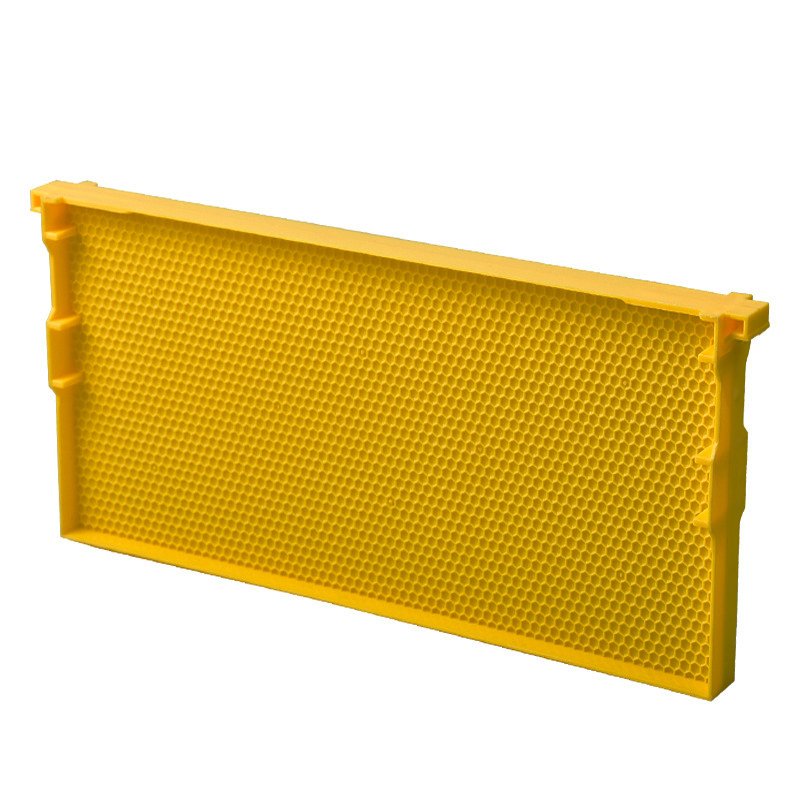
Three specification items follow from the residue picture. Plastic foundation removes the pooled-wax problem at a stroke, because there is no imported residue load in a sheet that contains no wax. Where wax foundation is specified, the specification should state the permitted residue levels and require a test report rather than a claim. And where a buyer is supplying a market that tests honey at the border, the frame and foundation choice belongs in the same document as the treatment plan, not in a separate purchasing file.
Strips and dispensers are part of the same decision, because the hardware determines whether the label can be followed. A strip that has to stay in place for 42 to 56 days needs a frame spacing that holds it in the brood nest for that long, and a dispenser has to deliver the stated dose at the stated temperature range. Where a product is applied outside its label window, the residue outcome is no longer predictable from the tolerance table.
On the product side, fluvalinate strips are the synthetic option with the longest wax persistence and the one that most needs a comb-replacement schedule behind it; an adjustable formic and acetic acid dispenser sits at the other end of the scale, since organic acids are exempt from tolerance and do not accumulate. Where wax foundation is the specified product, ask for a residue report on the actual lot: beeswax foundation sheets and the wider frame and foundation range should both ship with documentation that names the laboratory.

Questions buyers ask before they send samples
Is there a legal EU limit for residues in beeswax? No. MRLs under Regulation (EC) No 396/2005 cover honey and other apicultural products; beeswax has no EU MRL for these compounds, despite its use in food coatings and cosmetics. Wax is controlled by buyer specification and by organic standards such as the Italian working limits of 0.2 mg/kg coumaphos and 0.1 mg/kg fluvalinate.
Why is the EU amitraz limit 0.2 mg/kg when the US figure is also 0.2 ppm? They were harmonised deliberately. EPA’s 2013 tolerance rule states that 0.2 ppm for honey was chosen because it would cover residues from in-hive use and would harmonise with the EU level. The US honeycomb tolerance of 9 ppm has no EU equivalent.
Do organic acid treatments need a withholding period? Formic acid and oxalic acid products are exempt from tolerance in the US, and several are labelled for use with supers on — but “exempt” is not the same as “unrestricted”. The label still carries a temperature range and an application method, and following it is what keeps the exemption valid.
How long does a coumaphos or fluvalinate residue last in comb? On any practical beekeeping timescale, indefinitely. The Swiss national survey detected bromopropylate and tau-fluvalinate residues decades after the products were withdrawn. The only reduction route is removing and replacing the comb.
Can rendering old comb into new foundation reduce the load? No — it raises it. Bogdanov and colleagues measured an average concentration factor of about 1.7 through recycling. Rendering concentrates residues rather than removing them.
What should a foundation supplier be asked for? A certificate of analysis from an accredited laboratory dated within twelve months, reporting coumaphos and fluvalinate in mg/kg with the LOQ, plus the wax origin. A claim of clean or filtered wax is not evidence.
Is one honey test per season enough? Only if the crop is a single homogeneous lot. A test describes the drum it was taken from, so sampling has to follow the lot structure of the crop, and the treatment log has to identify which apiaries contributed to which lot.