
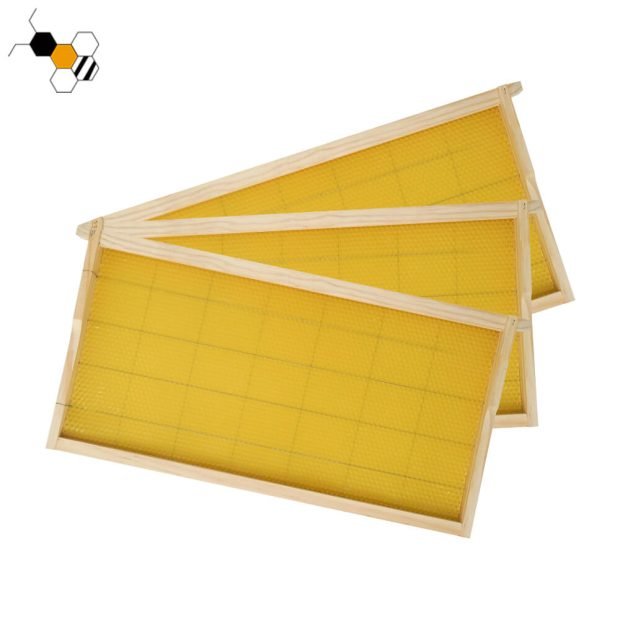
Cell size is the one foundation specification that gets argued about without anybody producing a drawing. A buyer asks for 4.9 mm, receives a sheet, and the arguments start only when the comb is drawn and somebody measures it. Before any of that, two decisions have to be separated: the cell width stamped into the sheet, and the material the sheet is made of. They are traded as one line item, but they behave differently in the field, and the cost of getting either one wrong falls on different people.
This piece is written for buyers ordering by the pallet or the container, not for a hobbyist deciding between two sheets in a shop. It covers the plastic vs beeswax foundation cell size question in the form it actually reaches a purchasing desk: what the millimetre figures mean, what the published varroa research found and did not find, what the wax coating does to acceptance, how beeswax adulteration is tested before it reaches a hive, and what to write into a bulk order so that a container of foundation arrives usable.
One thing is stated up front because it decides the tone of everything below. The research on cell size and varroa reproduction does not support a claim that smaller cells control mites. That is the position of the peer-reviewed work, cited with years in the section on varroa. What cell size does change is measurable and real: the comb the bees end up with, the weight of wax a colony has to spend, and the compatibility of a sheet with a frame already in service.
How cell size is quoted, and why two suppliers mean different things by 5.1 mm
Worker cell width is quoted in millimetres, measured across the flats of the hexagon with the cell walls included. That last phrase is the whole problem. Across-the-flats and across-the-corners measurements on the same comb differ by a meaningful fraction of a millimetre, and a supplier who does not state which one is being used cannot be compared with one who does.
Berry, Owens and Delaplane were explicit about it in their 2010 Apidologie paper, defining small-cell as 4.9 ± 0.08 mm cell width “walls inclusive” and conventional as 5.3 ± 0.04 mm. Coffey, Breen, Brown and McMullan, also in Apidologie in 2010, used 4.9 mm and 5.4 mm foundation from a single manufacturer, drawn out by a single colony, precisely so that the manufacturer and the drawing colony could not confound the comparison. Any specification you send to a factory should copy that discipline: state the measurement method, not just the number.
The practical way to check a sample sheet in a warehouse is to measure ten cells in a row and divide by ten. It is crude, it is what most of the trade does, and it is enough to catch a supplier who is shipping 5.3 mm product against a 4.9 mm order. Anything tighter than that needs a calibrated gauge and a written method agreed before production.
Nominal worker cell sizes and where each figure comes from
The table below lists the sizes quoted in the trade and in the literature. Note which row has a measured value behind it and which one is only a nominal catalogue figure. That distinction matters when a buyer is asked to pay a premium for a size.
| Nominal worker cell width (mm) | Where the figure comes from | What it means in practice |
|---|---|---|
| 4.9 mm | Small-cell foundation in Berry, Owens & Delaplane, Apidologie 41(1), 2010; measured 4.9 ± 0.08 mm | Smallest size sold in volume. Colonies not already on small cell often draw it wider than stamped, so the delivered comb drifts back toward standard within a season or two |
| 5.1 mm | The historic “five cells to the inch” standard, about 5.08 mm, quoted as standard in early wax foundation; also used as the middle step in the Arista Bee Research Foundation BMaT stepwise reduction 5.4 → 5.1 → 4.9 mm | Intermediate size. Common in Europe. Sits between the two groups that have been tested against each other in published trials |
| 5.2 mm | Nominal size quoted by some suppliers. No measured value from a published trial was found — ask the supplier for a measured drawing | Between the tested 4.9 mm and 5.3 mm groups, so no published comparison covers it directly |
| 5.3 mm | Conventional-cell control in Berry, Owens & Delaplane (2010); measured 5.3 ± 0.04 mm | Close to the working standard on modern wax foundation in North America |
| 5.4 mm | Standard-cell foundation in Coffey, Breen, Brown & McMullan, Apidologie 41(5), 2010 | The reference point most of the small-cell debate is measured against |
Two things follow from that table. First, the gap between the smallest and largest commonly quoted worker cell size is about half a millimetre, and the entire published argument sits inside it. Second, the intermediate sizes are largely untested: trials compare extremes, and a buyer ordering 5.1 or 5.2 mm is ordering something the literature does not speak to directly.
What the varroa research actually found, by study and year
This is the section that gets quoted back at suppliers, so it is set out with sources and years and without claims the papers did not make.
The most-cited trial is Berry, Owens and Delaplane, “Small-cell comb foundation does not impede Varroa mite population growth in honey bee colonies”, Apidologie 41(1):40–44, 2010. Three independently replicated field studies compared colonies on small-cell (4.9 ± 0.08 mm) against conventional-cell (5.3 ± 0.04 mm). In one of the studies, small-cell colonies ended with significantly more bees: 14,994 ± 2,494 against 5,653 ± 1,082. They also ended with significantly more mites in brood (359.7 ± 87.4 against 134.5 ± 38.7), a higher percentage of the mite population in brood (49.4 ± 7.1% against 26.8 ± 6.7%), and more mites per 100 adult bees (5.1 ± 0.9 against 3.3 ± 0.5). On the remaining ending varroa metrics the mean trends for small-cell were unfavourable. The authors concluded that small-cell comb technology does not impede varroa population growth.
Coffey, Breen, Brown and McMullan, “Brood-cell size has no influence on the population dynamics of Varroa destructor mites in the native western honey bee, Apis mellifera mellifera“, Apidologie 41(5):522–530, 2010, ran the cleanest experimental design of the group. Test colonies held alternating small and standard cell size brood combs over three months; all colonies were infested with mites from a host colony beforehand to raise infestation to a workable level; 2,229 sealed cells were opened. Small-sized cells were more likely to be infested than standard cells, but mite intensity and abundance were similar in both. The authors stated there is no evidence that small-cell foundation would help contain mite population growth, and that its use as a control method would not be proposed.
That paper also summarises the two earlier attempts. Taylor et al. (2008) in New Zealand and Ellis et al. (2008) in the United States tested potential benefits and, in Coffey’s reading of them, did not produce a consistent advantage for small cell. A separate field study in Experimental and Applied Acarology (DOI 10.1007/s10493-009-9314-7), sampling drone and worker brood combs from 11 colonies, found that infestation rate increased positively and linearly with the width of worker and drone cells, that the reproduction rate for viable mother mites was 0.96 viable female descendants per original invading female, that no significant correlation was observed between brood cell width and the number of offspring, and that infertile mother mites were more frequent in narrower brood cells.
The position as of the current literature is summarised by the Arista Bee Research Foundation’s Bee Management & Integrated Treatment (BMaT) project, which is still running. It describes existing small-cell studies as inconclusive, particularly in combination with varroa-sensitive hygienic stock, and is breeding small-bee stocks by stepwise reduction from 5.4 to 5.1 to 4.9 mm across multiple seasons. Read together, the published work does not establish that smaller cells reduce mite reproduction, and the largest trial running point in the other direction.
| Study / year | Design | Cell widths compared (mm) | Main result | Authors’ conclusion |
|---|---|---|---|---|
| Berry, Owens & Delaplane, Apidologie 41(1):40–44, 2010 | Three independently replicated field studies | 4.9 ± 0.08 vs 5.3 ± 0.04 | Small-cell colonies had more bees in one trial (14,994 ± 2,494 vs 5,653 ± 1,082) but also more mites in brood (359.7 ± 87.4 vs 134.5 ± 38.7) and more mites per 100 adult bees (5.1 ± 0.9 vs 3.3 ± 0.5) | Small-cell comb technology does not impede varroa population growth |
| Coffey, Breen, Brown & McMullan, Apidologie 41(5):522–530, 2010 | Alternating small and standard combs in the same brood box, one manufacturer, one drawing colony, 2,229 sealed cells opened | 4.9 vs 5.4 | Small cells more likely to be infested; mite intensity and abundance similar in both sizes | No evidence small-cell foundation would contain mite population growth; not proposed as a control method |
| Taylor et al. (2008, New Zealand) and Ellis et al. (2008, USA), as summarised in Coffey et al. (2010) | Field trials | Small vs standard | Summarised as not showing a consistent benefit | Same direction as the two 2010 papers |
| Experimental and Applied Acarology, DOI 10.1007/s10493-009-9314-7 | Drone and worker brood combs from 11 colonies under natural conditions | Continuous width, worker and drone | Infestation rate rose linearly with cell width; 0.96 viable female descendants per invading female; no significant correlation between cell width and offspring number; infertile mothers more frequent in narrower cells | Brood cell size modifies mite reproductive behaviour without changing offspring number |
| Arista Bee Research Foundation, BMaT project (ongoing) | Stepwise reduction 5.4 → 5.1 → 4.9 mm on pre-selected varroa-resistant stock, multi-season | 4.9–5.4 | No published result set yet | Existing small-cell studies described as inconclusive |
None of that is a causal claim in either direction, and it should not be sold as one. What can be said honestly to a customer is that peer-reviewed field trials published in 2010 found no varroa control benefit from small cell, that one study from the same period found an effect on mite behaviour rather than on mite numbers, and that the question is still being worked on by breeding programmes. What cannot be said is that a 4.9 mm sheet will reduce a customer’s mite counts.

Plastic against beeswax: acceptance, draw-out speed and rework
Separate cell size from material and the comparison becomes straightforward. Beeswax foundation is drawn faster and more completely, and it is the safer choice where the colony is weak, the flow is marginal, or the frames have to be drawn on a deadline. Plastic foundation is slower to accept, survives extraction and wax moth, and is reused across seasons. Which of those matters more depends on what the operation is optimising for.
Acceptance is the consumer of labour. A sheet the bees ignore becomes a frame that has to be pulled, re-coated or replaced, and in a commercial yard that is a second visit with the same labour cost as the first. Under a strong nectar flow beeswax sheets are typically worked on within days. Plastic sheets are worked on reliably when they carry a heavy wax coating and are introduced into a box that has no wax alternative; introduced alongside wax sheets in the same box, they are the ones left until last.
The commonly recommended management response is to run a box entirely on plastic rather than mixing, and to put new frames between two drawn combs. Both are ways of removing the choice. Neither is a substitute for a coating that is thick enough to smell like wax, because the coating is the thing the bees respond to.
Draw-out speed has a second cost that buyers often miss: incomplete draw on plastic produces burr comb and uneven cell depth, and uneven comb is the thing that jams uncapping machinery later. The rework shows up at extraction, not at installation. That is the argument for specifying coating weight in grams per sheet rather than accepting a description like “wax coated”.
The wax coating is the specification that decides acceptance
On plastic, the coating does the work that the material cannot. Published and trade guidance is consistent on the mechanism: bees respond to the scent and texture of beeswax, a bare polymer surface gives them neither, and a thin factory spray is frequently not enough to trigger drawing. Suppliers sell this distinction as single, double or triple waxed product, and the price step between the tiers is the price of that extra wax plus the extra handling.
Buyers should treat “wax coated” as an unspecified claim. What to ask for instead:
Coating weight per sheet, in grams. A number per side is better. Without it, a low-cost sheet can carry a film that looks waxy in a photo and disappears in a hive.
The wax source. Coating wax should be clean, traceable wax, not recovered wax of unknown origin. Recovered wax carries pesticide and varroacide residues, and those residues end up in the comb the colony rears brood in. Laboratories such as FoodQS offer residue packages for exactly this reason, covering pesticides and varroacides relevant to beekeeping.
Coating integrity after transport. Coated sheets rub against each other. The trade answer is interleaving paper and a carton that holds the stack still; the buyer-side answer is a receiving check that looks at sheets from the middle of the stack, not the top one.
Re-coating before installation. For operations that buy uncoated or lightly coated product and apply their own wax, the published practical guidance is to melt wax in a double boiler or a dedicated melting pot rather than over an open flame, and to apply it with a foam roller so the coating reaches the cell indentations. Rough handling of hot wax is a burn and fire risk, and it belongs in the yard’s safety paperwork, not just in a product note.

Beeswax adulteration: the risk, the tests and the standards to name
Beeswax is a limited, priced raw material, and that makes it a target. Laboratories that test wax for the trade describe paraffin as the most commonly detected adulterant, with stearin and animal or vegetable fats used to stretch genuine wax. For a buyer, the consequence is not only a sheet that draws badly: adulterated wax introduces hydrocarbons into comb that will hold brood and honey.
The screening shortcut that the industry leans on is total hydrocarbon content, and it is weaker than it looks. FoodQS notes that natural total hydrocarbon content varies between 11.6% and 17.7% in the literature, so a wax reading 17% may be genuine or may carry up to 4.4% of foreign hydrocarbons. Their recommendation is gas chromatography, which determines the concentration of foreign hydrocarbons such as paraffin or ceresin regardless of the total hydrocarbon figure. That is the test to name in a specification.
Other methods in common use: Fourier-transform infrared spectroscopy for a fast screen against a reference spectrum, saponification value and acid value as paired indicators of ester content, melting point against a monograph limit, thin-layer or liquid chromatography for rosin acids, and atomic absorption or ICP methods for heavy metals. Chinese testing laboratories summarising the national standard GB/T 30359-2013 list the same cluster of parameters and quote a natural beeswax melting range of about 62–67 °C; because that figure is a laboratory summary rather than the standard text itself, confirm the value against the certificate of analysis rather than treating it as a limit.
The standards worth naming in a purchase contract, depending on destination market:
European Pharmacopoeia — the beeswax monograph parameters, including acidity value, saponification value and melting point. Used by pharmaceutical and cosmetic buyers and widely accepted as a purity reference.
Regulation (EC) 231/2012 — the quality criteria for beeswax as food additive E901. Relevant where the wax or the comb will be in contact with honey sold for food.
RAL-GZ041 — the German quality assurance specification for beeswax candles, which includes total hydrocarbon content among its parameters. Relevant for candle-grade wax, which competes for the same supply.
GB/T 30359-2013 — China’s national beeswax standard, covering sensory, physical-chemical and hygiene indices. Useful when sourcing from Chinese mills, since it is the specification a domestic mill is likely to be working to already.
On residues, the same laboratories offer pesticide and varroacide packages because agricultural and beekeeping chemicals accumulate in wax and can migrate into honey stored in that comb. For a buyer shipping foundation into the EU, EU 2021/904 sets residue limits for certain substances in beeswax and is worth naming explicitly.
The rule of thumb for procurement: a certificate of analysis that states only “100% pure beeswax” is a marketing sentence. A report that gives the GC foreign-hydrocarbon result, the acidity and saponification values, and the melting point against a named monograph is a test report. Ask for the second one, and ask for it per production batch rather than once a year.
Bulk buying: tolerances, breakage and what shipping does to a pallet
Foundation is a high-volume, low-unit-value, fragile line. Most disputes about it come from three places: a dimensional drift nobody specified, sheets that arrived cracked or warped, and a coating that arrived rubbed off. All three are preventable with a specification, and none of them is covered by a catalogue photograph.
Breakage. There is no published, industry-wide breakage rate for foundation in transit, and any figure quoted without a test method behind it is a guess. The honest position is that breakage varies by source and model — ask the supplier for a measured test report, specifically a drop test and a compression test on a packed carton, together with the pallet stacking pattern. Then write an acceptable-damage percentage into the contract against that report rather than against a round number.
Heat. Beeswax sheets deform well before they melt. A container on a hot routing is the single most common cause of a wax-foundation claim, and the risk is highest for full-depth sheets stacked under load. Plastic sheets have the mirror-image problem: the heat-deflection temperature depends on the resin grade, and grades differ by factory. Ask which resin is used, ask for its food-contact declaration, and ask for the heat-deflection figure. Where neither can be supplied in writing, treat the shipment as a summer risk and route or time it accordingly.
Cold. Polymer sheets that survive heat can still crack on impact in cold weather. If the receiving yard unloads in winter, the question to ask is not the ambient rating of the resin but whether the cartons are packed to stop sheets flexing during handling.
Packaging. Specify interleaving, carton strength, and whether pallets are stretch-wrapped and corner-boarded. A pallet of foundation that shifts in transit arrives as a pallet of cracked sheets regardless of how good the sheets were at the factory.
| Check | Why it matters | Document to ask for |
|---|---|---|
| Cell width tolerance (mm) | A drift of 0.1 mm moves a 4.9 mm sheet out of the size the customer paid for | Dimensional report stating the measurement method — across flats, walls inclusive |
| Sheet flatness and camber (mm) | Warped sheets jam frame grooves and crack under wiring | Flatness specification plus photographs of a stacked pallet |
| Coating weight per sheet (g) | The coating, not the cell size, drives acceptance | Coating weight per sheet in grams, with the wax origin stated |
| Wax purity | Adulterated wax draws poorly and contaminates comb | GC report for foreign hydrocarbons; CoA against Eu. Ph., EC 231/2012 or GB/T 30359-2013 |
| Drop and compression performance | Breakage in transit is the largest single source of claims | Drop-test and compression-test report with the pallet stacking pattern |
| Heat resistance | Summer container temperatures deform wax and warp polymer | Melting range (wax) or heat-deflection temperature for the named resin grade (plastic) |
| Food-contact status | Comb holds honey that is sold as food | Declaration of compliance for the resin and for any coating, against the destination market’s framework |
Timing the order and the install, both hemispheres
Foundation has to arrive before the flow it is meant to be drawn on, and the two hemispheres do not share a calendar.
Northern hemisphere — North America and Europe. Draw-out happens on the spring and early summer flow, roughly April to June for most of the continental USA and the EU. Frames go in as the colony expands, and the order needs to be landed and cleared by February to March to leave time for re-coating and for frame assembly. Late autumn is the wrong time to push new foundation: colonies are contracting, there is no flow to pay for wax production, and sheets go into winter undrawn.
Southern hemisphere — Australia, New Zealand, Chile, Argentina and South Africa. The equivalent window is roughly September to December, with queen rearing and split-making running into it. Orders need to be on the water by July to August. Because Australia and New Zealand also carry the strictest wood-packaging rules in the region under ISPM 15, and because the southern spring is when mating nucs and splits consume the most equipment, foundation is best consolidated into the same container as frames and boxes rather than shipped alone.
For buyers supplying both, the useful habit is a single annual purchase split into two shipments: a larger one landed ahead of the northern spring, and a smaller top-up landed ahead of the southern one. It flattens the factory’s production load and it keeps wax-coated stock from ageing in a warehouse through a hot summer.
What to write into the purchase specification
The summary below is the short version of everything above, in the form it can be pasted into an inquiry.
State the cell size with its method. “4.9 mm worker cell, measured across flats, walls inclusive, ± tolerance stated” is an order. “4.9 mm” is a conversation.
Decide material by the operation, not by price. Beeswax foundation sheets for fast draw, weak colonies and tight seasonal windows. Full-depth plastic frames with an integrated foundation sheet where frames are extracted hard, reused for years, and where wax moth or rough handling would destroy wax comb. Plastic foundation sheets for operations that want the durability without changing the whole frame. The full range sits under the bee frame and beeswax foundation category.
Specify coating weight in grams per sheet and ask for the wax origin and its residue test. The coating is the acceptance variable.
Ask for a GC foreign-hydrocarbon report per batch plus acidity, saponification and melting point against a named monograph. Do not accept a purity claim without numbers.
Demand a drop and compression test with the pallet pattern, and set an acceptable-damage percentage against it. Breakage without a test method is an argument nobody wins.
Do not sell cell size as mite control. The 2010 field trials published in Apidologie found no such effect, and one found the opposite trend. Mite management still runs on monitoring and treatment thresholds; the Honey Bee Health Coalition’s varroa guidance remains the reference point for those thresholds, and the EPA pollinator protection pages cover what is registered for use. Pollination and colony-health background from FAO is useful context for buyers writing internal justifications. Where a customer wants to read the cell-size trials first-hand, the Coffey et al. paper is available through its DOI, and third-party laboratories such as SGS run the wax and polymer testing named above.
Order to the hemisphere’s calendar. Landed by February to March for the northern flow, by July to August for the southern one.
The two decisions at the top of this piece are worth repeating because they are the ones that get collapsed into one: the millimetre figure is a dimensional specification and should be bought like one, with a tolerance and a measurement method. The material is an operational choice and should be bought against how the frames will be handled, extracted and stored. Cell size is not a varroa tool, and a supplier who sells it as one is selling something the published work does not support.