

A shipment of wooden hives can be turned back at the port for reasons that have nothing to do with the joinery. The timber is legal, the boxes are well made and the buyer is waiting — and the paperwork does not line up. Wood is one of the few materials where the documentation travels with the goods and is checked by an authority that has no interest in the product.
Three separate regimes now apply to wood in trade, and they are frequently confused with each other. Certification shows where the fibre came from. Phytosanitary treatment covers the packaging that carries it. And deforestation due diligence is a newer legal obligation that sits on the importer and reaches back to the forest plot. This article separates them, sets out what each document actually proves, and finishes with the pack to check before a container sails.
Certification: what FSC and PEFC answer
Forest certification is a voluntary chain-of-custody scheme. It answers one question: can the wood in this box be traced through every step back to a forest that was managed to a published standard? It does not certify quality, strength, or compliance with any law.
Two organisations dominate. The Forest Stewardship Council operates its own international standard and certifies both forest management and chain of custody. The Programme for the Endorsement of Forest Certification endorses national systems rather than running a single global one, so a PEFC claim is made against a national standard that PEFC has assessed. In practice most buyers accept either, and the choice usually follows the customer’s market: FSC is stronger in parts of Europe and among retail brands with public procurement commitments, PEFC is widespread among small forest owners in Europe and has strong coverage in several producing countries.
| Element | FSC | PEFC |
|---|---|---|
| Structure | Single international standard | Endorsement of national systems |
| What the supplier must hold | Chain-of-custody certificate with a licence code | Chain-of-custody certificate issued under a recognised national scheme |
| What appears on the invoice | Claim, product description and the certificate code | Claim, product description and the certificate code |
| Claim systems | Transfer, percentage and credit systems | Percentage-based methods alongside physical separation |
| Typical failure | Claim printed without a valid code on the invoice | Certificate scope does not include the product being sold |
The failure modes in the last two rows are worth reading twice, because they are the two most common problems in practice. A carton printed with a certification claim is a trademark use, not evidence: the invoice has to carry the claim and the certificate number for the buyer to make their own claim downstream. And certificates are scoped. A chain-of-custody certificate covers a defined list of product groups and a defined site, and a factory that certifies pine furniture components does not automatically cover hive bodies made from a different species.
For the exporter the obligation is narrow but real: hold a valid certificate covering the product, show the claim and code on the transaction documents, and keep the purchase and sales records that let the volumes reconcile. Where a claim is made under a percentage or credit system, the percentage has to be applied correctly on the document, not just on the box.
Species, and why the scientific name matters
Hive bodies are made from a small set of softwoods, and the trade names are not standardised. Chinese fir — Cunninghamia lanceolata — is widely used in Chinese manufacture because it is light, stable and easy to work. Radiata and other pines are common in Australian and New Zealand supply. Cedar and paulownia appear where low weight is the priority.
Trade names overlap badly. “Cedar” in one market is not the species a buyer in another market expects, and a certificate that names only a trade name may not be accepted where a botanical name is required. For export documentation, the safe practice is to name the species botanically on the specification and packing list, alongside the trade name where one is in common use.
Species also matters for the regulation. Under the EU Deforestation Regulation, wood and wood products in scope require geolocation of the plot of harvest, evidence of legality under the producing country’s law, and a due diligence statement. The European Commission’s deforestation-free products pages explain what operators must be able to demonstrate, and the scheme’s entry into application is staged: 30 December 2026 for medium and large operators, with most micro and small operators following on 30 June 2027. That staging matters for anyone quoting now for delivery after the end of this year, because the obligation sits with whoever first places the goods on the EU market.
The Commission also runs a country benchmarking system that classifies producing countries by deforestation risk, which changes how much due diligence is required. The list is maintained and revised, so it is worth checking the current version rather than relying on what it said a year ago.
Packaging is a separate rule
Wood fibre as a product and wood as packaging are treated differently, and the packaging rule is the one most often forgotten because it is applied to something the buyer does not sell.
Solid-wood packing material — pallets, crates, dunnage — has to be treated and stamped under ISPM 15 before it can enter most countries. The stamp carries the IPPC symbol, the country code, the producer’s registration number and the treatment abbreviation. The standard is maintained under the IPPC standards framework, which publishes the current treatments and mark requirements.
The failure mode here is mundane and common: a pallet repaired with an unmarked board, or a crate built from untreated timber because the packaging supplier changed. Either can hold a container while it is treated, re-packed or destroyed, and the cost lands on whoever is named as consignee. When a quotation includes crating, ask what the crates are made from and whether the stamp is branded into the wood.
Documents that prove timber origin
Certification schemes and deforestation law ask for overlapping but not identical evidence, which is why a single certificate is rarely enough. The table below is the practical set for wooden hive exports.
| Document | Who issues it | What it proves |
|---|---|---|
| Chain-of-custody certificate | Accredited certification body | The supplier is certified to sell the product with the claim |
| Invoice and packing list carrying the claim and certificate code | Supplier | The specific consignment is covered by the certificate |
| Species declaration | Supplier | What the timber actually is, ideally with botanical names |
| Country or region of harvest | Supplier, backed by purchase records | Where the fibre originated |
| Geolocation of the plot of harvest | Supplier’s upstream chain | The deforestation-free requirement under EUDR |
| Legality evidence | Supplier’s upstream chain | Compliance with the producing country’s law |
| ISPM 15 treatment mark | Approved treatment provider | The wood packaging is treated |
| Phytosanitary certificate, where required | National plant protection organisation | The consignment meets the importing country’s plant-health rules |
Two columns in that table are where most exporters are weakest. Geolocation is often unavailable two or three steps up the chain, particularly where a mill buys from many small growers, and the requirement is for the plot rather than the district. Legality evidence is the other: it is not a single certificate but a bundle — harvest rights, compliance with land use, tax, labour and environmental obligations — and it has to be assembled before the goods are placed on the market, not retrieved afterwards.
The practical consequence for a buyer is that timber documentation is a supplier qualification question, not a shipping question. Ask what the mill can produce for a consignment before the order is placed, because a pack that cannot be assembled in three weeks is a pack that will not be assembled at all.
Specifying the wood itself
Certification and legality are separate from whether the box lasts. The specification for a hive body should carry the species, the moisture content, the grade, the joint type, and the finish, because those are the properties a buyer can check on arrival and the properties that determine service life.
Moisture content matters most for stability. Timber that is too wet when it is machined will move after assembly, and a box that is square in the factory can be out of square in a container three weeks later. Timber that is too dry costs more for no benefit. The right figure depends on the destination’s equilibrium conditions, which is worth specifying as a range with a tolerance rather than a single number.
Grade determines how much of a board is usable and how many knots appear on a visible face. For hive bodies, which are painted and structural, a lower grade is usually appropriate; for top bars and frames, where fit is closer, grade matters more. Finish is the last variable: raw timber needs protection before it leaves the yard, and the choice between dipping, brushing and spraying changes both the cost and the coverage on end grain, which is where water enters first.
These are the specifications a supplier can quote against and an inspector can check, which is what makes them worth writing down. Where a specification is silent, the factory’s usual practice becomes the standard, and that is rarely what either side intended.

Document pack checklist before the container sails
- Chain-of-custody certificate in date, with the licence or certificate code that will appear on the invoice.
- Confirmation that the certificate scope covers the product being shipped — species and product group, not just the site.
- Invoice and packing list carrying the claim, the code and the species named botanically.
- Country or region of harvest recorded, with purchase records behind it.
- Geolocation data for the plots where the timber was harvested, where the destination requires it.
- Legality evidence for the producing country, including land and labour obligations.
- Due diligence statement reference, where the destination operates a deforestation regime.
- ISPM 15 treatment mark branded on every solid-wood pallet, crate and dunnage board.
- Phytosanitary certificate obtained where the importing country asks for one.
- Timber specification on the order: species, moisture range with tolerance, grade, joint, finish.
- Supplier’s own purchase and sales records retained long enough to reconcile volumes.
- Pack verified by photograph before loading, including the stamps.
The certification schemes publish their own requirements: the Forest Stewardship Council for FSC claims and PEFC for the national systems it endorses. Neither is a substitute for the other regimes, and none of them is a substitute for a specification that says what the box is made of.
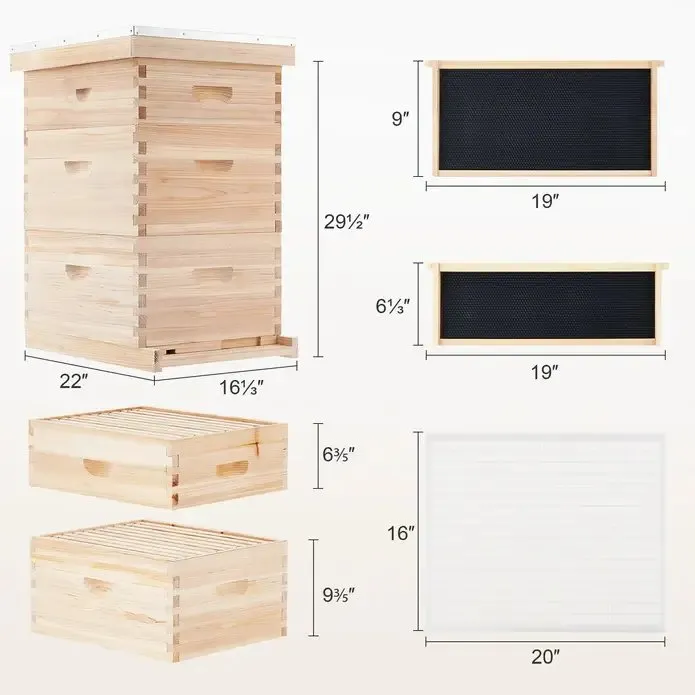
On the product side, timber choice is visible in the catalogue. A Chinese fir hive kit is the lighter, easier-to-handle option and is what most volume buyers in Asia specify, while an 8 or 10 frame pine hive suits markets where pine is the expected material and the boxes take more handling. Both are built from components in the hive components range, and the specification questions above apply equally to either.