
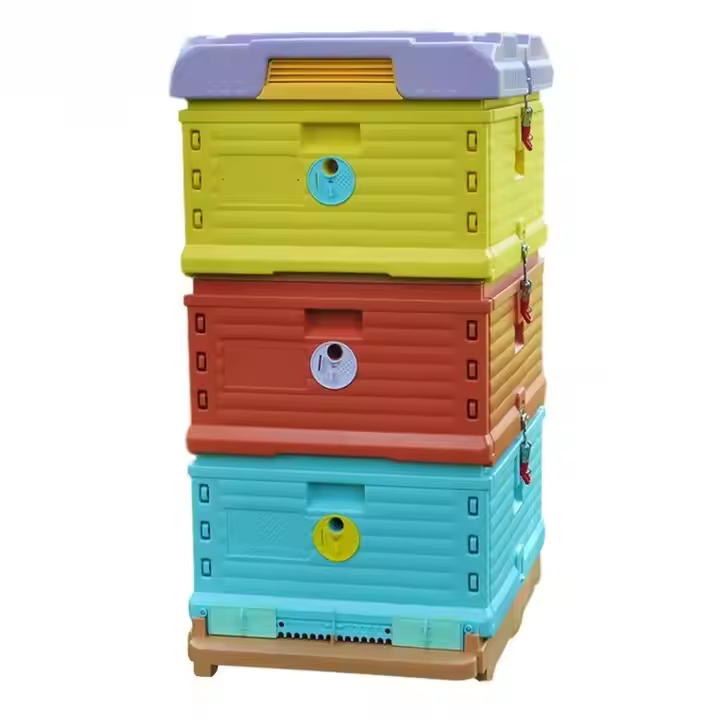
The floor of a hive is the cheapest component on the bill and one of the few that changes how you manage the colony above it. A screened bottom board gives you ventilation and somewhere to put a mite tray; a solid board gives you warmth, a lower price and nothing to read. Arguments about which is better tend to be settled by anecdote, so this article works from the three published sources that actually measured something: the varroa thresholds published by the Honey Bee Health Coalition, a multi-year Polish study of winter loss by floor type, and the Pacific Northwest survey work that compared the two directly. That is the basis for screened bottom board varroa monitoring decisions in a commercial yard or in a container order.
What each floor actually does
A solid bottom board is a closed panel. It holds heat, keeps debris and cappings inside where the bees can deal with them, costs less to make, and has no moving parts. Its weakness is that it tells you nothing: mites that fall off bees land on the floor and crawl back onto a host.
A screened bottom board puts a mesh panel in place of that floor, typically built with 1/8 inch hardware cloth — about 3 mm aperture, which passes mites and small hive beetles and holds bees. Mites that fall go through and cannot return. The same aperture gives the colony ventilation it would not otherwise have, and it creates a slot underneath where a sticky tray or an oil tray can be slid in.
Most commercial designs add a removable insert: a solid panel that slides in under the mesh for winter and out again in spring. That hybrid is the specification most operations should default to, because it converts a fixed choice into a seasonal one.
Mite drop counts: what the screen gives you and what it does not
This is where the strongest claim for screened floors is also the weakest. A screen makes mite-drop counting physically possible. It does not make it accurate.
The Honey Bee Health Coalition publishes treatment thresholds by colony phase in its Tools for Varroa Management guide, expressed as mites per 100 adult bees. The Honey Bee Health Coalition varroa pages carry the guide and the supporting material. Those thresholds are below.

| Colony phase | Acceptable (mites per 100 bees) | Caution (mites per 100 bees) | Danger (mites per 100 bees) |
|---|---|---|---|
| Dormant, with brood | Below 1% | 1–2% | Above 2% |
| Dormant, without brood | Below 1% | 2–3% | Above 3% |
| Population increase | Below 1% | 2–3% | Above 3% |
| Peak population | Below 2% | 3–5% | Above 5% |
| Population decrease | Below 2% | 2–3% | Above 3% |
The guide is blunt about how to get those numbers: an alcohol wash or a soap wash, or a powdered sugar shake. It also lists natural mite drop among the sampling methods it does not recommend relying on for treatment decisions. That is the part of the screened-floor argument that gets left out of supplier marketing.
The reason is structural. A drop board counts mites that fall on their own. Roughly four in five mites are inside capped brood at any given moment, so the board sees a slice of the population, and the size of that slice moves with brood area, ambient temperature and colony strength. A nuc dropping five mites a day is in worse trouble than a double-deep dropping fifteen. The same count means different things in May and in October.
So the honest position for a buyer is this: a screened floor is a screening tool, not a measuring instrument. Use it to decide which hives to wash, and use the wash to decide whether to treat. A yard running 500 colonies cannot alcohol-wash 500 colonies every fortnight; it can read 50 trays in an afternoon and wash the ten that look worst.
Converting a drop count, if you must
A field rule of thumb divides the 24-hour natural drop by ten to estimate infestation percentage: 20 mites per day implies roughly 2%. Extension sources quote divisors anywhere between eight and fourteen depending on colony size and brood coverage, and the spread is the point — it is an estimate with real error in it, not a measurement. Treat the output as a triage signal and confirm with a wash before you spend money on treatment.
Ventilation and moisture: the summer case
The summer argument for a screened floor is not about mites. It is about moisture and heat.
A strong colony moves a lot of air. An open floor adds an exhaust path at the bottom of the stack, which helps when the colony is curing nectar and needs to evaporate water, and it reduces the temperature inside a box standing in direct sun. In hot, humid regions that is a genuine advantage, and it is the reason screened floors are close to standard equipment in the southern United States and in much of Australia.
Debris handling is the second benefit. Wax cappings, pollen and dead bees fall through instead of accumulating, and small hive beetles drop through into an oil tray if you run one. On a solid floor the same material builds up on the bottom board and becomes a beetle and wax moth habitat.
Winter: where the evidence disagrees
Nothing in this subject is argued as hard as whether to close the screen for winter, and the published work points in two directions.
A multi-year Polish study of winter colony losses found the effect was ambiguous. Where colony losses were driven by varroa-related collapse rather than by starvation, screened floors were associated with an overall loss rate roughly 2 percentage points lower. But among colonies showing starvation symptoms, screened floors were associated with a significantly higher loss rate. The authors’ explanation is straightforward: extra ventilation increases temperature fluctuation, bees in a thin-walled hive with an open floor burn more energy maintaining cluster temperature, and they need more food to get through.
A separate study using temperature and humidity sensors inside hives with permanently open screened floors found colonies thermoregulated as well as those on conventional floors, even under winter conditions in a Mediterranean climate, and concluded there was no additional risk from open floors. Mild climate, thin-walled hives, and no starvation pressure — which is a different situation from a cold continental winter.
Survey work tells a third story. Analysis of Bee Informed Partnership national survey data found that screened floor use did not improve winter survival in any survey year when compared directly with solid floors, and experimental trials found either no reduction in mite populations or a reduction of roughly 10% at best. One survey year showed northern beekeepers losing about 10% fewer colonies on screens than southern beekeepers.
Put together: a screened floor is not a winter survival treatment, and it is not a mite treatment either. It is a monitoring and ventilation tool whose winter effect depends on whether your colonies die of mites or of cold and hunger. If your losses are mite-driven, leaving it open probably helps. If your losses are starvation-driven, close it.
Choosing by climate

| Condition | Floor specification | Winter action | Reason |
|---|---|---|---|
| Cold continental winter, mite-driven losses | Screened with removable insert | Leave open, feed generously | Monitoring benefit plus ventilation; the Polish data favours screens where collapse dominates losses |
| Cold continental winter, starvation-driven losses | Solid, or screened with the insert fitted | Close the screen from first hard frost | The same study found higher losses on open screens among starved colonies |
| Mild maritime winter | Screened, insert optional | Leave open | Sensor work found no thermoregulation penalty in mild winter conditions |
| Hot, humid summer, mild winter | Screened, permanent | Nothing to do | Ventilation and beetle trapping matter more than winter insulation |
| Hot, dry summer, cold winter | Screened with insert | Insert in, out at build-up | Both problems present, so make it seasonal |
| Migratory operation, almond or similar pollination | Screened with insert | Closed in transit | Open floors on a truck let cold air straight through the stack |
That last row is worth expanding. Colonies moved for pollination travel on open trucks at night. An open floor in transit is a wind tunnel, and it is also the configuration in which a sticky tray will be lost on the highway. Close it, and specify a floor whose insert can be operated with the boxes stacked, because nobody wants to break down a pallet of hives to slide a panel in.
Seasonal calendar: two hemispheres
Northern hemisphere. Fit the insert or close the screen from roughly October, once the first hard frost is near, and pull it at spring build-up in March or April. Read trays through the April to September monitoring season, with the counts that matter most taken in late July to September, before the winter bees are raised. Deep-clean and store trays over winter.
Southern hemisphere. Mirror it by six months. Close from roughly April at the autumn build-down, open again at spring build-up in September or October. The critical monitoring window is January to March, before the autumn bees are raised, and the tray-reading season runs October to March.
In both hemispheres the rule is the same: the tray counts that matter are the ones taken four to eight weeks before the colony stops raising brood. Counts taken after that are interesting and too late.
Specifying screened floors for an import order
If you are buying rather than building, six specification points decide whether the floor works and whether it survives a season outdoors.
| Specification | What to ask for | Why it matters |
|---|---|---|
| Mesh aperture | Stated in mm on the quotation; 1/8 inch hardware cloth is the common build, about 3 mm | Too coarse and bees pass or get trapped; too fine and wax and debris block it |
| Mesh material | Stainless or galvanised wire, stated grade, not “mesh” | Rust at the bottom of a hive is a constant damp environment |
| Screen area versus frame area | Screen covering the full footprint under the frames | A partial screen undercounts drop and skews every reading |
| Tray clearance | Enough height under the mesh for a tray to slide without disturbing the screen | A tray that cannot be pulled is not a monitoring system |
| Insert design | Solid panel that slides in from the front or rear with boxes stacked | A panel that requires dismantling the hive will never be used |
| Timber or plastic body | Species and grade stated; or UV-stabilised plastic with a stated resin | The floor is the wettest part of the hive and rots first |
For distributors, the stocking decision follows the climate table rather than the price list. Sell screened floors with inserts in temperate markets and permanent screens in hot ones, and stock the trays separately — they are cheap, they are replaced more often than the floor, and they are the item that keeps the customer coming back.
Context for the whole discussion: varroa remains the leading stressor reported by US operations with five or more colonies in every quarter NASS surveyed in 2025, at 21.8% of colonies in January–March 2026 and 26.3% in April–June 2026, and the 2025–2026 US Beekeeping Survey recorded 30.3% winter loss and 39.9% annual loss. A floor that makes monitoring cheap is worth something in that environment. The FAO pollination pages set out the wider context on managed pollinators and crop dependence.
Questions buyers ask
Does a screened bottom board reduce varroa enough to skip treatment? No. Trials found either no reduction in mite populations or about a 10% reduction at best, and the Honey Bee Health Coalition does not list natural drop among the methods it recommends for treatment decisions. Treat it as monitoring, and treat the colony on the basis of a wash.
Should I close the screen in winter? It depends on what kills your colonies. Where losses are mite-driven, the Polish data found open screens associated with roughly 2 percentage points lower overall loss. Where colonies starve, open screens were associated with higher loss, because extra ventilation raises the energy cost of keeping the cluster warm. If you do not know which applies to you, fit an insert and close it.
What mesh size should I specify? The common commercial build is 1/8 inch hardware cloth, about 3 mm aperture. Ask for the figure in millimetres on the quotation, because “hardware cloth” is sold in several gauges and the wrong one either blocks with wax or lets bees through.
Can I use a drop count instead of an alcohol wash? Not as a decision method. Use drop counts to rank colonies and decide which ones to wash. The divide-by-ten conversion exists, but extension sources quote divisors from eight to fourteen, which tells you how much error is in it.
Do screened floors make a hive colder? They add ventilation, and the measured effect on winter survival is small and inconsistent between studies. In a mild winter, sensor work found no thermoregulation penalty. In a cold continental winter with thin-walled hives, the colony pays for it in food.
Is a screened floor worth the extra cost on a 500-colony order? If you monitor mites on a schedule, yes — the labour saved on sampling is worth more than the price difference. If you treat on a calendar regardless of counts, the monitoring value disappears and the solid board is cheaper and warmer.
What about small hive beetles? An oil tray under the screen catches them, and that is a real secondary benefit in warm, humid regions where beetle pressure is continuous. It is not a control programme on its own.
Floors are one component in a hive that has to work as a system. Where insulation matters as much as ventilation, a moulded body such as the 3-layer insulated plastic beehive changes the calculation, because a well-insulated box tolerates an open floor better than a thin-walled one. Where you run solid floors and cold winters, moisture control above the cluster matters more — a wooden quilt box does that job. Floors, boxes and covers are specified together in the hive components and kits range, and for the counts themselves a dedicated tester such as the varroa easy check gives you a number you can act on rather than an estimate.